
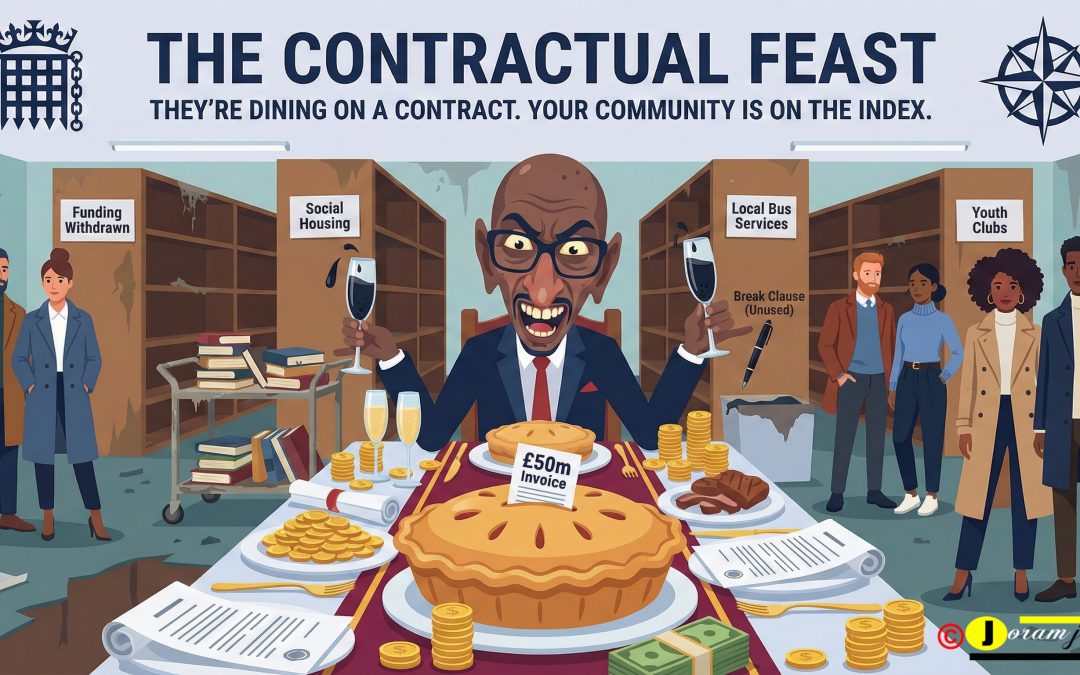
The £715 Million Failure: How the UK’s Rwanda Deportation Deal Collapsed into a £50 Million Lawsuit
In a stark exposé of failed immigration policy, the United Kingdom faces a £50 million legal claim from the Rwandan government after the controversial deportation scheme was abruptly scrapped. This lawsuit, lodged with the Permanent Court of Arbitration in The Hague, marks the dramatic final chapter of a deal that cost British taxpayers an estimated £715 million without achieving its core aim. The agreement, initially signed by former Home Secretary Priti Patel in 2022, saw the UK pay £290 million to the dictatorship of Paul Kagame, yet resulted in zero forcible deportations and only four voluntary relocations.
New Prime Minister Sir Keir Starmer declared the scheme “dead and buried” days after the 2024 election, but the government’s failure to formally terminate the contract has triggered a fierce financial dispute. Rwanda alleges the UK owes a further £50 million instalment, a payment originally forgone only if the scheme proceeded. This legal clash unfolds as official data reveals the policy’s fundamental flaw: Channel crossings increased by 41% between 2023 and 2025, disproving the central claim that the threat of removal to Rwanda would act as an effective deterrent.
 This comprehensive analysis traces the scheme’s journey from a political headline to a fiscal and humanitarian scandal. We examine the National Audit Office’s revelation of an unused break clause, the staggering breakdown of costs including chartered flights that never departed, and how a policy meant to deter migration instead created a lucrative revenue stream for an authoritarian regime while eroding public trust and diverting vital funds from British communities.
The Polite Shakedown: When the Mask of Governance Slips
In the hushed, wood-panelled theatre of international arbitration, a performance is underway that lays bare the true script of modern power. The Rwandan dictatorship, having played its assigned role in Britain’s border theatre, is now presenting its final invoice: a £50 million claim for a performance that never officially closed. This is not a mere contractual dispute. It is the moment the hired stagehand turns to the director and demands payment for a play that was booed off the stage, revealing the entire production to be a transaction built on a shared fiction. The age-old practice of robbing Peter to pay Paul takes on a grotesque, globalised form: Peter is the British taxpayer, and Paul is an authoritarian regime, with both governments acting as the accomplices in the transfer.
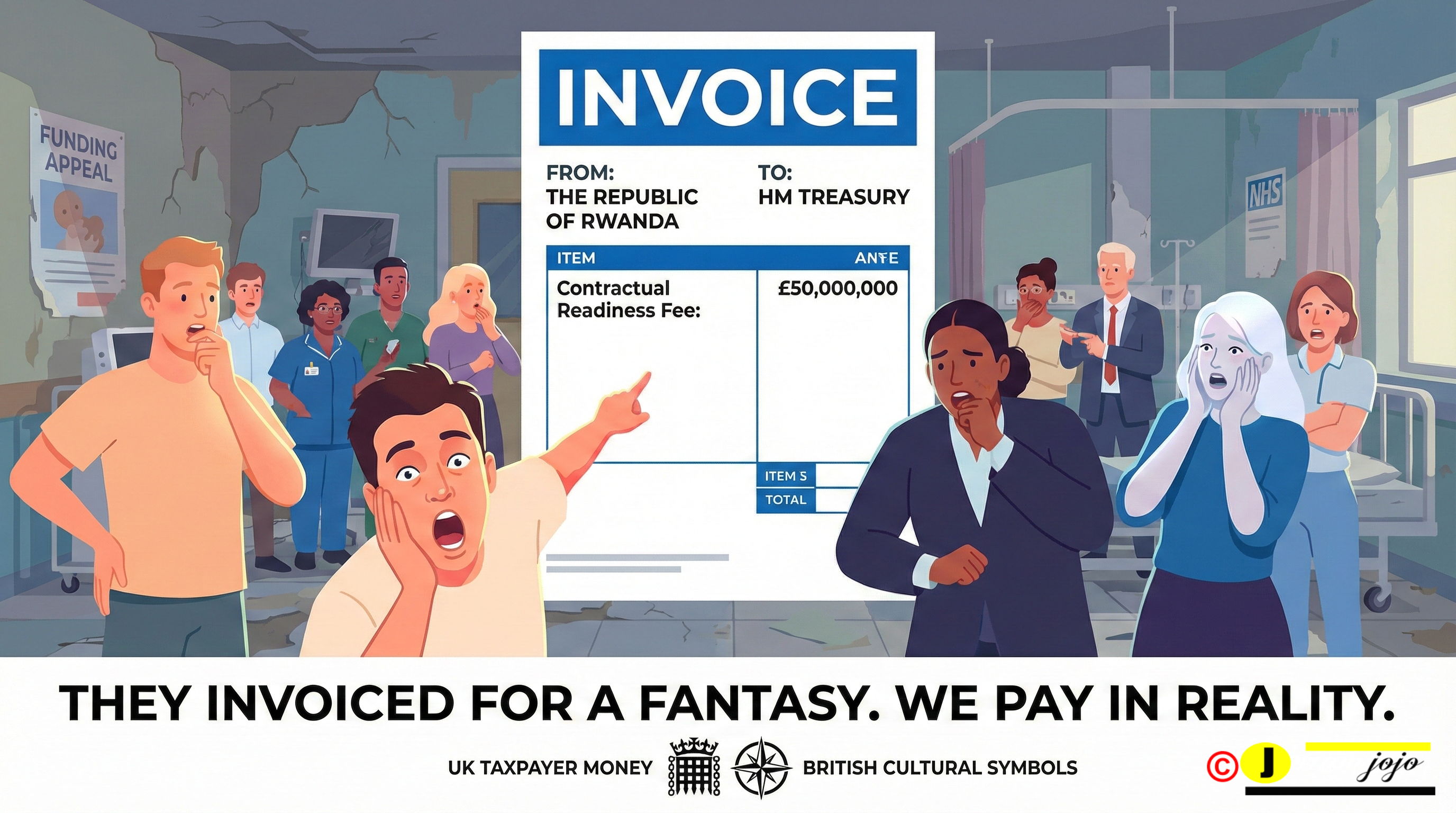 This spectacle in The Hague offers a brutal clarity. It demonstrates that the vast, complex apparatus of border control is not primarily about security or order. It is a lucrative cross-border industry. In this venture, the displaced human being is reduced to a unit of account—a source of political pressure to be monetised, a liability to be managed for profit. The British state, or at least the faction that designed the scheme, was not purchasing safety; it was purchasing a political narrative, outsourcing a politically toxic function to a regime with a different threshold for domestic criticism. The Kagame dictatorship, in turn, was not offering sanctuary but leasing its sovereign territory and its reputation for rigid control, converting its geopolitical position into a recurring revenue stream.
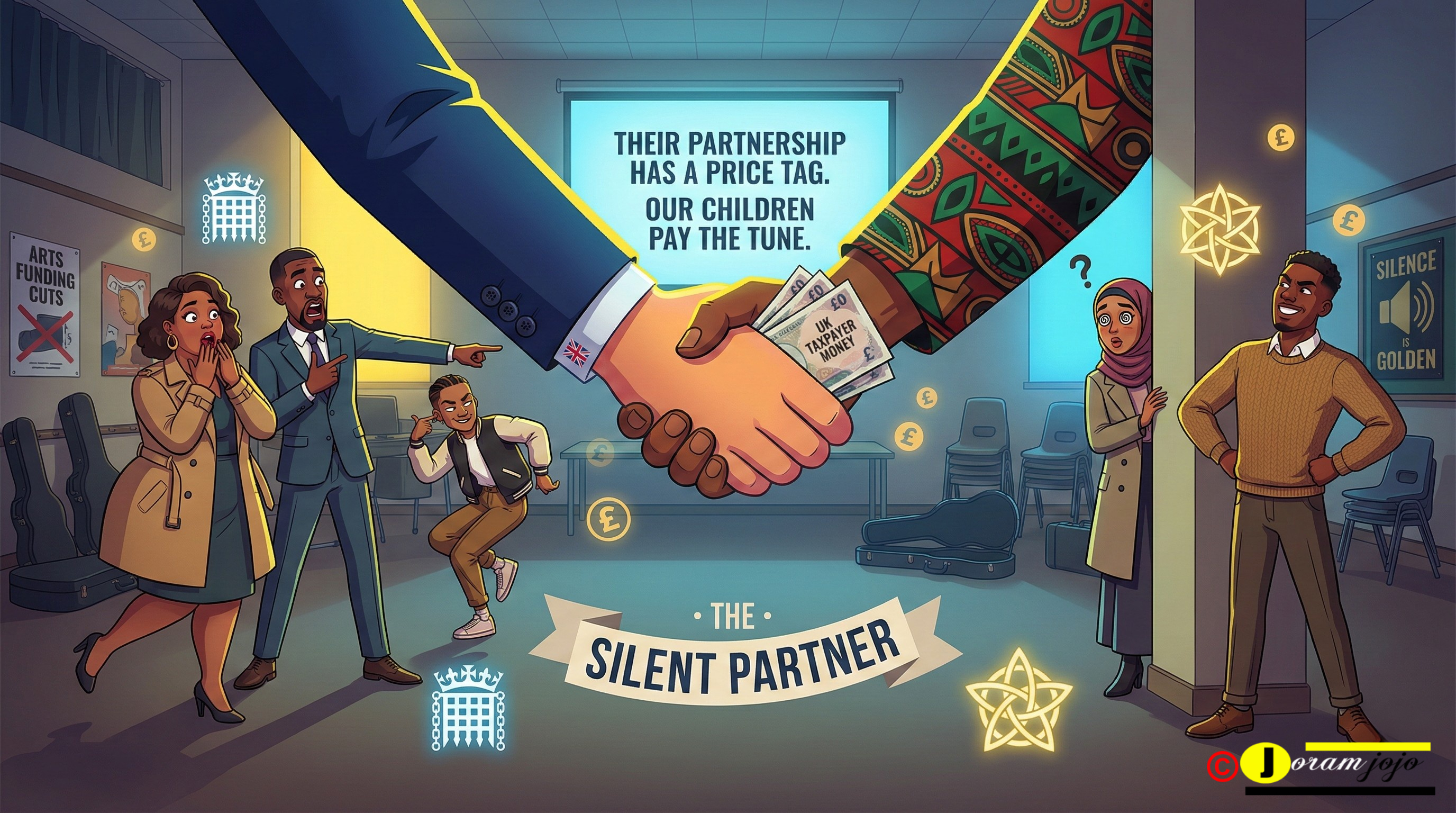 The lawsuit strips away the final layers of pretence. All the humanitarian language of ‘partnership’ and ‘capacity building’ evaporates, leaving behind the dry language of contractual obligations and termination clauses. The dispute centres not on whether the deal provided refuge or safety, but on whether the British state correctly filed its paperwork to end a financially toxic arrangement. The fate of migrants, the alleged purpose of the entire exercise, is entirely absent from the legal debate. They have served their purpose as the nominal subject of the contract; now, only the money matters.
This is the essence of the modern border game. It is a system that creates a crisis—real or perceived—and then sells itself as the only solution, diverting public funds into a nexus of private contractors, security firms, and accommodating foreign regimes. The £715 million squandered on the Rwanda scheme represents the staggering overhead cost of maintaining this fiction. The £50 million lawsuit is the logical next line in the balance sheet: a claim for a broken promise, where the promise itself was to participate in a morally broken system.
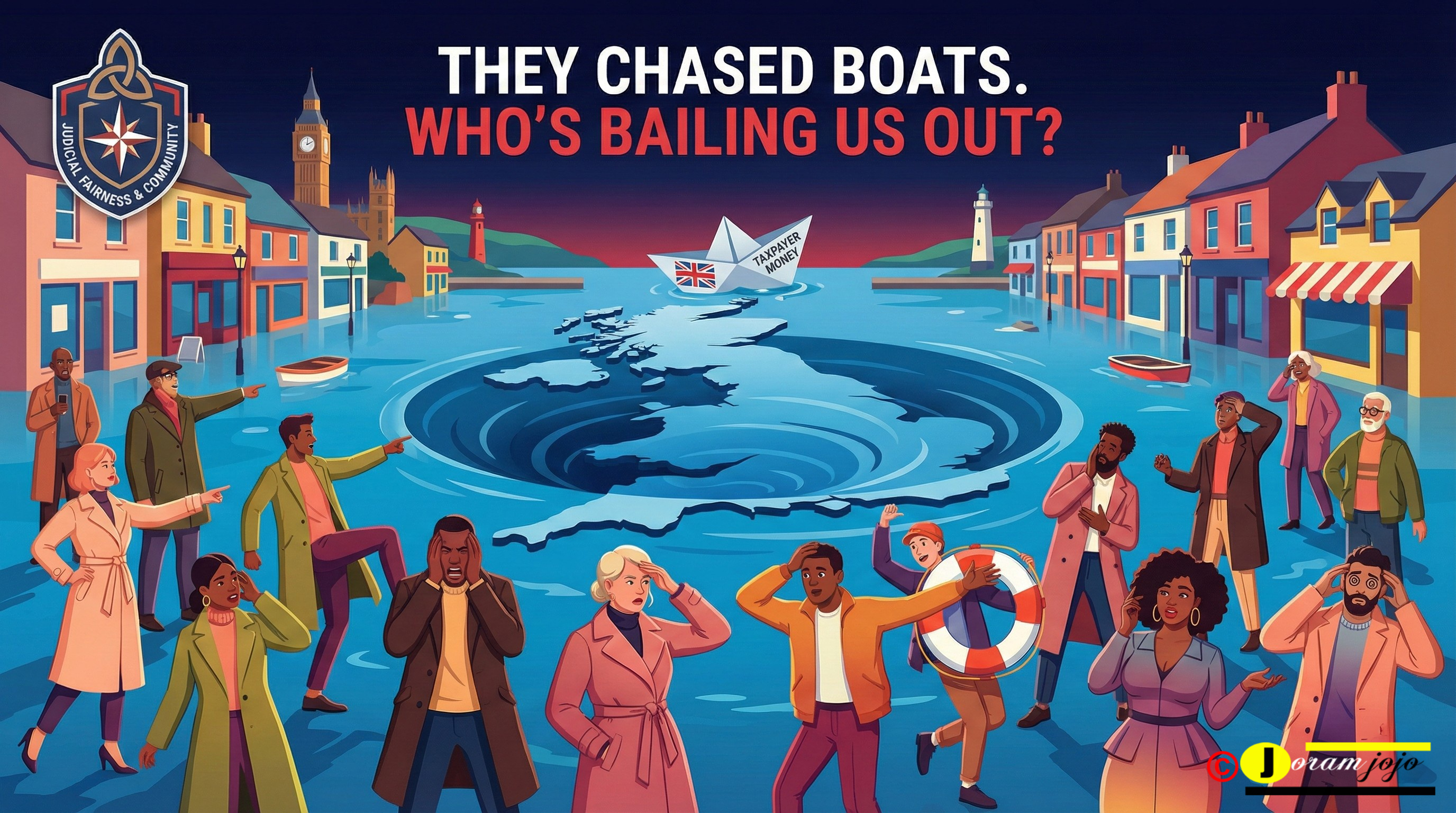 The ultimate revelation is that this industry requires perpetual conflict to survive. It needs the boats to keep coming, the headlines to remain urgent, and the public to believe in the spectre of invasion, because without that fear, the multi-billion pound edifice of walls, surveillance, detention, and offshore deals collapses. The lawsuit from Kigali confirms that even when the policy fails, the financial pipelines it created remain active, seeking their toll. It proves that the real borders being fortified are not around nations, but around wealth and power, designed to ensure that the profits from this theatre of cruelty continue to flow upwards, while the human cost is borne by the most vulnerable, and the financial cost is dumped at the public’s door.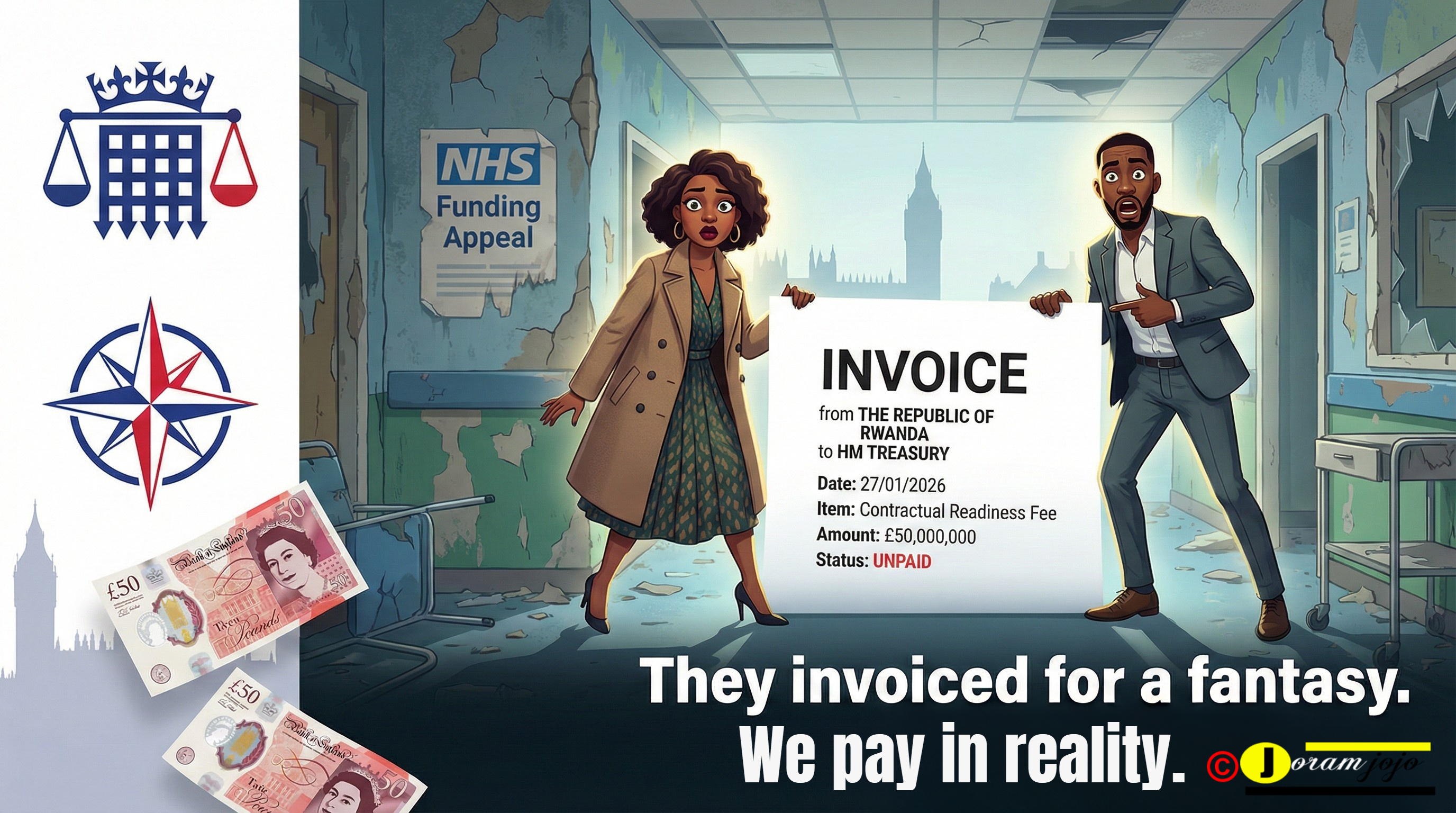
Twenty Points of Analysis: Deconstructing the Deal
-
The Gilded Cage: How Britain Paid a Dictatorship to Play Jailer
The heart of this sorry affair is a staggering piece of political theatre, so brazen it would be comical if it weren’t so costly. Picture the scene: British ministers, clutching their briefing papers, stood in Parliament and solemnly declared Rwanda a “safe third country” for asylum seekers. This, while human rights organisations filed report after report detailing the less-than-safe realities of that regime—allegations of suppression, disappearances, and a political space tighter than a drum. It’s the oldest trick in the book: pay someone else to do the dirty work you can’t be seen to do yourself. The age-old adage about ‘the wolf in sheep’s clothing’ springs to mind, though here it’s less about disguise and more about a straightforward business proposal. The wolf was hired as a shepherd, and the British state wrote the contract.
Let’s pull this apart.
Calling Rwanda “safe” under the current dictatorship wasn’t an error of judgement; it was the entire, grubby point. The designation was never a genuine assessment of civic freedom or human rights. It was a required legal and rhetorical key, purchased at great expense, to unlock a trapdoor under the feet of people seeking sanctuary. The UK government, bound by its own laws and courts which have historically blocked the removal of people to genuine danger, needed a fig leaf. It found one in Kigali, carefully stitched together with banknotes.
This is the cold mechanics of offshore oppression. When a state wishes to inflict a violence—in this case, the traumatic, indefinite exile of vulnerable people to a place they do not know—but fears the legal and electoral backlash of doing it within its own borders, it seeks a subcontractor. The Rwandan dictatorship, with its highly centralised control and keen eye for international revenue streams, was the perfect candidate. The regime’s leader, Paul Kagame, presides over a nation touted for stability and growth, yet that stability is built on a foundation of enforced silence and concentrated power.
 For a government wrestling with the spectacle of Channel crossings, this was a feature, not a bug. A partner that could guarantee no messy protests, no independent courts causing trouble, no pesky local opposition getting in the way of the hotel construction projects funded by British aid.
So, the money flowed. £290 million as a down-payment for a service: the absorption of British political anxiety. The “Hope Hostel” in Kigali, spruced up with UK funds, stands not as a beacon of refuge, but as a monument to this transactional brutality. It was never about providing a new home. It was a holding pen in a deal that treated human beings as units of political stress to be exported.
The stunning hypocrisy is laid bare by the lawsuit itself. Now that the music has stopped, the dictatorship is meticulously parsing the contract it signed, leveraging the very legalism the UK hoped to sidestep. They are holding Britain to the small print of a deal that was, in essence, about bypassing the spirit of law itself. The regime’s justice minister becomes a corporate executor, invoicing for a deterrent that didn’t deter, for a service never rendered. It proves, with perfect clarity, that their commitment was always to the ledger, not to the people.In the end, this core contradiction reveals a sordid truth about modern statecraft. When confronted with a complex human reality like migration, the instinct of power is not to address root causes or build humane systems. It is to engineer distance—geographic, legal, and moral. It is to turn suffering into a line item, find a willing partner in the shadows, and hope the public doesn’t look too closely at the man behind the curtain. They have looked now. And the view is nothing but a mirror, reflecting our own capacity for institutionalised cruelty, beautifully formatted and expensively receipted.
-
A Pantomime of Punishment: The Rwanda Scheme That Never Was
To understand the Rwanda plan, one must first appreciate the fine British art of political escapology. A government in a tight spot, grappling with the consequences of its own policies and the relentless spectacle of small boats in the evening news, needed a diversion. Not a solution, mind you—a diversion. Something bold, simple, and brutal enough to grab headlines and signal decisive action. Thus, the scheme was born not in the careful deliberations of statecraft, but in the frantic backrooms of political survival. It was, as the old saying goes, an attempt to sell snow to Eskimos—a product utterly redundant to its intended market, whose only value was in the audacity of the sale.
This was policy as a magician’s flourish: a dazzling gesture to distract from the empty box. The then-Home Secretary, Priti Patel, inked the deal with the Rwandan dictatorship in 2022 with the solemn air of someone solving a crisis. Yet, within government and legal circles, the whispers were unanimous. The plan was riddled with legal, practical, and ethical holes so vast it could never function as advertised. It was less a plan and more a costly bluff.
The impracticality was the point. The goal was never to actually build a functioning system for asylum. The goal was to create a story of toughness. A story to tell certain voters. A story to spook potential migrants. A story to plaster over internal party divisions. Every courtroom challenge, every human rights objection, could be woven into this story—framed not as evidence of a failed policy, but as proof of a meddling “establishment” the government was bravely fighting.This is where the calculation turns from cynical to downright grotesque. Knowing the scheme would likely be bogged down in the courts indefinitely, the government signed cheques anyway. Hundreds of millions were allocated, not as investment in a working system, but as the necessary stage budget for a political theatre production. The £290 million sent to Kigali wasn’t payment for a service; it was a down-payment on a political narrative. The costs for phantom flights, for vast legal teams, for detaining and releasing people—all this was written off as collateral damage in a culture war.
The ultimate proof of this bad faith lies in the reaction to its collapse. When Labour finally called time on the pantomime, the architects of the scheme expressed outrage not at the waste, but at the loss of the deterrent. The deterrent that never deterred a soul, as crossing numbers soared. Their fury confirmed the truth: the scheme’s real purpose was to exist as a threatening idea, not a functioning reality. Its failure in practice was irrelevant to its success as a political symbol. -
Penny Wise and Pound Foolish: The £715 Million Fiction
Let us speak plainly of the money. Not in the abstract, bloodless language of Whitehall spreadsheets, but in the concrete reality of what £715 million represents. It is the annual salaries of 23,000 nurses. It is the building of twenty-five new primary schools. It is a lifeline for every food bank, community centre, and public library facing the axe. Instead, this sum—this colossal harvest of taxation—was gathered, bundled, and set alight in service of a single, failed idea.
The phrase ‘fiscal violence’ is not hyperbole. It describes the conscious decision by those in power to divert resources essential for collective well-being into a project designed to inflict suffering. Every pound spent on the Rwanda scheme was a pound actively taken away from the crumbling infrastructure of care and community in Britain. It was money stripped from the pockets of those who work, to be handed to contractors, lawyers, and the treasury of a central African dictatorship. It was the state, in its most perverse form, functioning not as a steward of the common good, but as a mercenary agency, using public funds to finance its own theatre of cruelty.The breakdown of the cost is a study in grotesque extravagance. Nearly £300 million handed directly to the government of Paul Kagame, a regime with a documented indifference to political dissent. Millions more on chartering aircraft that never left the tarmac, their empty seats a perfect metaphor for the entire endeavour. Vast sums spent imprisoning people within the UK, only to release them when the fiction became unsustainable. Over a thousand civil servants, their talents, and time consumed not by solving housing or healthcare crises, but by administrating a fantasy.
This is where the adage ‘penny wise and pound foolish’ curdles into something far darker. The government postured about saving money on asylum hotels, all while constructing a money incinerator of unparalleled scale. They fetishised the cost of a migrant’s temporary accommodation while writing blank cheques for their own political vanity project. It was an accounting trick performed on the public conscience, a magician’s gesture distracting from the great vanishing act of community wealth.The ultimate insult, of course, is the £50 million now demanded in a Dutch courtroom. It is the final, farcical invoice for this fiscal violence. Having already taken so much, the scheme now reaches back from its grave to demand still more, arguing over a payment for a service that never was, for people who never arrived. The British public are told they must now pay extra for the privilege of having been deceived.
This is the true price of the political stunt. It is measured not just in the astronomical figure, but in every quiet casualty: the elderly person without care, the child in an overcrowded classroom, the community hub that closed its doors. The money was sacrificed at the altar of a harmful narrative, proving that when the state wishes to perform its power, it is always the people’s purse that pays for the props. -
The Emperor’s New Deterrent: A Fiction Woven from Data
The claim was as bold as it was simple: the mere existence of the Rwanda scheme would stop the boats. It was presented as an iron law of human nature—a terrifying spectre that would cause desperate people to recalculate their journeys. It was the political equivalent of hanging a scarecrow in a field and expecting the crows to flee the county. Yet, as the figures now show, the crows were not only unimpressed by the scarecrow, their numbers swelled. The data delivers a cold, numerical verdict: crossings rose by 41% between 2023 and 2025. The deterrent was a phantom; a story told to the public, and perhaps, in a triumph of wishful thinking, believed by its tellers.
This is the art of political magic: to declare something true so loudly and so often that its failure in the real world is treated as a minor irrelevance. The government, in its pronouncements, operated on a logic divorced from evidence. They sold a narrative of control, while every objective measure screamed of its absence. To invoke the well-worn adage, it was a classic case of ‘the emperor’s new clothes.’ The ministers paraded their magnificent, invisible deterrent, and a chorus of supporters applauded its fearsome design, while anyone with the temerity to glance at a statistics sheet could see there was nothing there at all.The persistence of the myth reveals its true purpose. It was never a policy outcome to be achieved, but a political shield to be wielded. When challenged on the rising numbers, the response was not revision or doubt, but a doubling down. The crossings were happening, they conceded, because people knew the scheme wasn’t yet operational. Or, perversely, they were happening because the scheme was so fearsome it was causing a rushed final dash. The logic became a closed loop, immune to facts. Success was claimed for the idea’s announcement; failure was blamed on its delayed implementation. The goalposts were not just moved, they were mounted on wheels and pushed gleefully around the pitch.The grim reality, of course, is that people fleeing conflict, persecution, and destitution are driven by forces far more powerful than the shifting announcements of the Home Office. The idea that a headline about Rwanda would outweigh the terror of a bombed hometown or the slow starvation of a refugee camp is not just naive; it is a profound insult to the intelligence of the British public and the desperation of those making the journey. It reduces epic tragedies of global inequality and war to a simple cost-benefit analysis, as if one were choosing a holiday destination based on a new airport tax.
Now, with the scheme defunct and the lawsuit hanging in the air, the final joke emerges. The dictatorship in Kigali, a partner in this performance, now uses the cold, factual language of contractual law to demand payment for the fictional deterrent’s final instalment. They are, in effect, sending an invoice for the emperor’s invisible robes. It is a fitting end for a project built on fiction: a legal claim arguing over payment for a threat that never materialised, a scarecrow that never scared a soul. The only thing truly deterred, it seems, was the government’s own grip on reality, and the taxpayer’s grip on their money. -
A Transaction in Suffering: The Ledger of Kigali
Beneath the polished veneer of international partnership and the clinical language of memoranda of understanding, a far more ancient and brutal arithmetic was at work. For the regime of Paul Kagame in Rwanda, the British government’s desperation presented not a humanitarian challenge, but a singular business opportunity. Here was a chance to convert geopolitical relevance and a carefully managed reputation into hard currency, with human beings as the central, if unspoken, unit of exchange.
The dictatorship’s calculus was precise and cold. Its offer to forgo a scheduled £50 million payment—but only if the scheme proceeded—lays the entire deal bare. It was the clause of a contractor, not a partner. People in distress were not to be sheltered; they were to be processed, their very movement transformed into a deliverable, a condition for payment. The arrangement brings to mind the old adage about selling rope to the hangman—a transaction utterly divorced from the end-use, concerned solely with the profit in the moment. Rwanda positioned itself not as a refuge, but as a specialist subcontractor for the politically toxic work the UK wished to outsource.
This was a masterful performance in political capitalism. The Kagame regime, celebrated in some boardrooms for its stark efficiency and stability, understood its market value to a Westminster government obsessed with spectacle. It offered a service: the absorption of political friction. In return, it demanded not only upfront investment in infrastructure and state coffers, but also the continued prestige of being a ‘solution’ to a Western dilemma. The gleaming Hope Hostel in Kigali, refurbished with UK funds, stands as a warehouse in this supply chain of human despair—a ready facility awaiting a shipment that, legally and morally, could never reliably arrive.The current lawsuit for the £50 million is the flawless finale to this performance. Having played its part, having stood ready to fulfil its side of a grim bargain, the regime now turns with steely professionalism to the small print. It engages elite London lawyers not in a diplomatic spat, but in a contractual dispute. The justice minister becomes a chief financial officer, issuing an invoice for a deterrent that never deterred, for a service never activated. It proves, with devastating clarity, that their commitment was always to the balance sheet. The well-being of migrants was incidental; the primary objective was the monetisation of a political crisis happening thousands of miles away.
In this light, the regime’s famed ‘development miracle’ reveals a darker facet. It is a system adept at converting every available resource—be it land, international goodwill, or the plight of the vulnerable—into capital and control. The UK deal was merely a new, macabre line of business. The tragedy lies not only in the British taxpayer being billed for a fantasy, but in the chilling demonstration of how power operates: reducing human life to a line item, and dignity to a negotiable condition in a payment schedule. The ledger of Kigali, now submitted in evidence at The Hague, is a document for our age, detailing the exact price we have agreed to put on our own humanity. -
The Paper Trap: How a Symbolic Victory Unlocked a Legal Vault
In the grand theatre of politics, grand announcements are made to the roar of headlines, while the dull, quiet work of governance continues in the backrooms. The Labour government, upon entering office, understood the symbolic power of killing the Rwanda scheme. They declared it “dead and buried” with the flourish of a conquering hero. Yet, in their haste to claim a political victory and close a rancorous chapter, they committed the most pedestrian of state errors: they neglected to file the paperwork. In doing so, they stepped from the stage right into a trap laid by the cold, precise mechanics of the system they sought to critique. It is a classic case of being hoist by one’s own petard—blown up by the very device you intended to use against others.
The agreement with the Rwandan dictatorship was not a gentleman’s handshake; it was a dense contract, crafted by expensive lawyers, brimming with clauses, sub-clauses, and termination protocols. Its architects, the previous government, had included a break clause—a three-month notice period that would cleanly end obligations without further penalty. This was the administrative off-ramp. By announcing the scheme’s end but failing to trigger this mechanism formally, the new government created a legal limbo. They had publicly interred the body but neglected to certify the death legally, leaving a ghostly contractual entity twitching on the floor.The Kagame regime, a master of realpolitik and legal formality, spotted the opening immediately. Their claim is not based on any moral argument about providing shelter or processing claims. It is not even an argument that they did anything. It is a stark, breathtakingly cynical argument about procedure. They are invoking the sanctity of the contract—the very instrument of high capitalism—to demand payment for a non-service. The £50 million is now portrayed as a fee for their continued contractual readiness, a standing charge for a phone line that never rang. The British state, which so often hides behind its own bureaucratic maze, finds itself entangled in someone else’s.
There is a profound irony here that borders on farce. A government that came to power criticising the scheme as a corrupt waste of money now must spend further millions of public funds on barristers to argue over a technicality in a deal it despises. They are forced to defend the state’s failure to correctly dismantle its own oppressive machinery. The lawsuit, therefore, becomes a perverse monument to statecraft itself: a fight between two powerful entities, conducted in the rarefied air of international arbitration, over a sum of money that represents absolutely nothing of tangible value. No flights, no security, no processing—just a penalty for administrative omission.The tragedy, of course, is that this entire costly pantomime—the initial scheme, its cancellation, and the subsequent legal claim—has been conducted entirely over the heads of the people it claimed to be about. The lives of asylum seekers remain in limbo, the communities denied £715 million in resources see no return, and the public trust is eroded further. The only certainties are invoices and legal fees. The trap was not sprung by Rwanda alone; it was built into the very nature of a system that believes human beings can be managed by contracts and that political gestures can trump procedural reality. The bill, as always, lands on the public’s doormat, marked for a debt they never agreed to owe, for a service that never existed. -
Selling the Bear’s Skin: The £50 Million Invoice for a Chase That Never Was
There exists a rather colourful old adage warning against selling the bear’s skin before one has caught the bear. It speaks to the folly of profiting from a potential future event that may never come to pass. The Kagame regime’s £50 million claim against the British state is not merely an example of this; it is its ultimate, bureaucratic perfection. They have presented a pristine invoice for the skin of a beast that was never pursued, captured, or seen. Not a single individual was forcibly removed to Rwanda under the scheme. Only four people, a number so derisory it underscores the whole farce, went voluntarily. And yet, from a boardroom in Kigali, arrives a demand for payment. This is capitalism stripped of even the pretence of product or labour; it is the pure extraction of value from a void.
Consider the sheer, bald-faced audacity of the demand. A service is, by any sane definition, an activity performed or a good delivered. The Rwandan state performed no processing, offered no lasting asylum, provided no sustainable integration for thousands as promised. The ‘Hope Hostel’ remained, for all intents and purposes, a monument to a hypothetical. The regime’s position is thus a masterpiece of capitalist alchemy: they have transmuted their mere contractual readiness—their willingness to be a participant in a scheme widely condemned as unlawful and cruel—into a multi-million pound asset. Their profit is derived not from success, but from the prolonged political failure and administrative negligence of their British counterparts.This transaction lays bare a disturbing modern truth: state power can be leveraged not just for control, but for rent. The dictatorship did not need to succeed in housing or processing a single soul to turn a profit. It merely needed the British government to remain entangled in its own legal and political web for long enough that a scheduled payment fell due. The £50 million represents a form of speculative finance, where the commodity being traded is the potential for state violence against displaced people. It is a futures market in human suffering, and the Kagame regime held the contract.The British government, first under the Tories and now under Labour, enabled this. One side designed a scheme so blatantly performative it was guaranteed to stall, yet kept the payments flowing. The other, desperate for a clean break, forgot to dot the administrative ‘i’s and cross the contractual ‘t’s, leaving the trap unsprung. Both, in their own way, treated the deal as a political abstraction rather than a concrete mechanism with real-world consequences. The Rwandan state, in contrast, treated it with the cold precision of a corporate raider, eyeing the clauses and the calendar.
The public is now asked to understand this £50 million claim as a legal complexity. It is not. It is a bill for nothing. A charge for a door that was never opened, a meal that was never cooked, a bed that was never slept in. It is the purest form of extraction, where value is siphoned not from labour or resources, but from the gap between political promise and reality. The bear was never caught, but the skin has been priced, invoiced, and is now the subject of a lawsuit in The Hague. The only thing being skinned, it seems, is the British taxpayer. -
The Letter of the Law: How a Safety Catch Became a Trigger
Buried within the hundreds of pages of the UK-Rwanda agreement, the National Audit Office—the state’s own financial conscience—unearched a critical detail: a break clause. A stipulated mechanism allowing the British government to terminate the arrangement by giving notice, walking away without incurring further financial penalty. This was not a minor footnote; it was the designed safety valve, the contractual acknowledgement that the entire edifice was experimental and potentially untenable. Its existence transforms the current £50 million lawsuit from a dispute over a breached promise into something far more revealing: a baroque argument over a semicolon. It proves the entire venture was less a partnership and more a speculative game with loaded dice, where the rules were written to be litigated, not followed.
The presence of this clause lays bare the exploitative DNA of the deal. It was structured not like a mutual commitment to a humanitarian endeavour, but like a corporate joint venture for a dubious mining project, complete with exit fees and penalty disputes. The Kagame regime, signing on the dotted line, knew its partner had a legally enshrined right to withdraw cleanly. Their current legal claim, therefore, hinges on a brutal technicality: that the UK government, in its political haste to announce the scheme’s demise, correctly failed to pull the very lever the contract provided. This is the realm of pure contractual formalism, where the spirit of the agreement—already morally barren—is entirely discarded for a fight over the letter. It brings to mind the old adage about the letter of the law killing the spirit. Here, the letter is being brandished not to uphold justice, but to extract a ransom for a nullity.This is where the mask of ‘migration partnership’ slips completely. A genuine partnership based on shared goals would not have such a clinically mercenary exit strategy at its heart. The break clause reveals the UK’s own latent distrust and the transactional cynicism both parties brought to the table. The subsequent lawsuit then becomes the inevitable second act. The dictatorship, employing one of London’s own elite commercial barristers, now uses the UK’s beloved tools of legalistic precision against it. They are not arguing that they housed thousands, or that their services were rendered. They are arguing that a bureaucratic step was missed. The goal is not to uphold cooperation, but to exploit administrative failure.
The profound tragedy for the public is that this entire debate—conducted in the gilded halls of international arbitration—revolves around a clause that was supposed to protect them from exactly this scenario. The escape hatch, built into the deal to limit liability, has become the very mechanism for a fresh demand. It demonstrates a chilling principle of modern statecraft: even the safeguards designed into systems of power can be reverse-engineered into weapons for further extraction. The state, in its clumsy dance with another authoritarian regime, forgot to read its own steps, and now the public must pay the band for the song that never played. The auditor’s revelation of the clause ultimately reveals the greatest flaw: the belief that human lives can be managed by the cold mechanics of contract law, a system always most adept at serving those who can afford the best lawyers to parse its infinite, profitable ambiguities. -
The Gallery of Gilded Gowns: How Suffering Funds the High Court Carousel
In a final, fitting twist to this saga, the battleground has shifted to the most rarefied arena of all: the commercial arbitration courts. Here, far from the choppy waters of the Channel or the sun-baked streets of Kigali, the final act is being staged. And the principal players are not politicians or civil servants, but silks. The Kagame dictatorship has instructed a London-based barrister, a crossbench peer, while the British state has enlisted its own top commercial litigator from the Inns of Court. This is the elite legal circus, and the ringmasters wear gowns worth thousands.
The adage that a fool and his money are soon parted feels apt, but here the fools are entire populations, and the money is being parted with ceremonial solemnity. This legal battle, a hyper-technical dispute over a defunct policy, will generate fees that could fund hospitals or schools. Instead, it will flow into the bank accounts of some of the most expensive professionals in the world, masters of a language and a system so complex they have built a golden temple around it. The British taxpayer, having already funded the scheme, now funds the defence against the invoice for the scheme. The Rwandan citizen, living under an authoritarian system, sees their state’s resources spent on hiring foreign legal aristocracy to pursue funds that will likely never benefit them.There is a grotesque symmetry to it. The Rwandan regime, which presents itself as a proud African sovereign, must engage the British legal establishment to sue the British government. It is a perfect-closed loop of elite reinforcement. The very system that drafted the exploitative contract—the world of London law, finance, and international deal-making—now profits from litigating its failure. They are the only guaranteed winners. Whether the UK pays £50 million or not, the barristers will be paid. Whether Rwanda receives a penny, their legal counsel will have sent an invoice.
This circus reveals where power truly resides in such conflicts. It does not lie with the public, who fund it, nor with the displaced people who were its theoretical subjects. It resides in the hands of a transnational professional class that translates political failure into billable hours. They are the alchemists of modern power, turning the base metal of governmental incompetence and authoritarian greed into pure legal gold for themselves.The courtroom in The Hague or London becomes a theatre of the absurd. Heated submissions will be made on the meaning of a termination clause, while the original, profound human questions at the heart of the policy are utterly irrelevant. The argument is no longer about safety, deterrence, or compassion. It is a sterile, financially lucrative debate about contractual semantics, a game played by masters where the scores are kept in hourly rates and the spectators foot the bill without ever understanding the rules. It is the final, logical stage of a venture that always treated people as commodities: now even the argument over its corpse is a for-profit enterprise. -
The Alchemy of Reputation: Gilding Control with Legal Gold
There is a particular genius in the manoeuvre, a deftness that turns stigma into asset. The Rwandan dictatorship, under Paul Kagame, has long faced a paradox: praised in some quarters for economic growth and stark efficiency, it is simultaneously critiqued for its suffocating control and documented human rights abuses. The UK’s deportation scheme presented a unique solution to this paradox. It offered a path to convert that very reputation for uncompromising control—a negative in many diplomatic circles—into a tangible, renewable resource. By positioning itself as Europe’s prospective border guard, the regime embarked on a brilliant piece of political alchemy, using the respectability of Western courts as its crucible.
This is the modern face of realpolitik, devoid of imperial banners but full of forensic invoices. The Kagame regime did not merely sign a contract; it entered a marketplace. Its commodity was its capacity to administer territory with an iron fist, to offer the “order” that European governments, in a panic over migration, desperately wished to purchase. The lawsuit now underway is not an embarrassment to Kigali; it is a strategic play in a longer game. By pursuing the £50 million through the hallowed, oak-panelled channels of the Permanent Court of Arbitration, the dictatorship achieves two transformative aims.First, it forces a form of legitimising recognition. Engaging in a complex contractual dispute in a Western forum elevates the disagreement from the realm of political grandstanding to that of a commercial dispute between sovereign states. It frames the regime not as a pariah, but as a contractual partner wronged by a larger, wealthier signatory that failed to follow due process. The very act of litigation implicitly reinforces the validity of the original agreement and the state’s standing as a reliable entity within the global system of contracts and law—a system that often politely overlooks internal repression when external deals are at stake.
Second, and more crucially, it proves the revenue model. The initial £290 million was a windfall. The claimed £50 million is a test case for sustainability. It sends a signal to other nations that might contemplate similar schemes: Rwanda is a serious, professional operator whose contractual expectations must be met, and whose cooperation has a clear, non-negotiable price. The goal is to institutionalise the role of “border enforcer” as a permanent, income-generating arm of the state, akin to a port authority or a tourism board. The suffering of the displaced, and the political anxieties of European electorates, become the raw materials for this new export industry.
 Thus, the lawsuit is far more than a claim for funds. It is a performance of power and professionalism aimed at future clients. It is the meticulous crafting of a brand. The adage that “the devil can cite Scripture for his purpose” finds its modern counterpart in the dictatorship that cites contractual law for its treasury. Every legal submission, every hour billed by their London counsel, reinforces the message: this is a state that understands and operates by your rules, and it will use your own systems to hold you accountable for every penny promised. The leverage gained is not just financial, but reputational, transforming what was once a liability into a strangely bankable form of international capital, all while the original human subjects of the deal remain powerless props in the theatre of their own exile.
 -
The Half-Measure: A Retreat That Advances the Enemy’s Cause
The Labour Party’s handling of the Rwanda scheme resembles a surgeon who, loudly condemning a tumour, only succeeds in slicing through a single visible vein. The bleeding becomes more dramatic, but the malignant growth remains. They declared the scheme “dead and buried” with the triumphant air of gravediggers, yet somehow left the legal coffin unsealed. This failure—whether born of staggering administrative negligence or a more calculated reluctance—reveals a profound and complicit hypocrisy. It demonstrates that their opposition was never to the underlying game, merely to the most politically damaging way of playing it.
One is reminded of the adage about cutting off one’s nose to spite one’s face. Labour’s political objective was clear: deliver a symbolic kill to a despised Tory policy and appease their base. But in focusing solely on the theatrical announcement, they neglected the procedural spadework, leaving their own government exposed to a £50 million lawsuit. This is either an epic failure of statecraft, suggesting a disturbing incompetence in basic governance, or it signifies something more telling: a tacit acceptance of the border regime’s core logic. By not surgically wielding the break clause crafted for this very purpose, they allowed the toxic premise of the deal—that human beings can be legally bargained and shipped—to retain a ghostly legal form.Now, their promised “robust” defence in court completes the picture of complicity. They will argue, no doubt with great vigour, that they owe Rwanda nothing. But in doing so, they must engage on the terrain established by the deal’s architects. They must parse the same clauses, debate the same timelines, and validate the same framework that treats border enforcement as a commercial subcontracting service. Their fight is not over the morality of the scheme, but over its invoice. In vigorously disputing the bill, they inadvertently affirm the legitimacy of the original transaction. They are not tearing up the rulebook of border militarism; they are merely quibbling over a disputed charge within its pages.
This is the constrained imagination of state power. Even when a party enters office criticising a policy as wasteful and cruel, its tools for undoing it are the same legal and bureaucratic tools that created it. The instinct is to manage the fallout, not to dismantle the factory. Labour’s position thus becomes one of regretful stewardship of a machine they find distasteful, rather than engineers of a wholly different system. They oppose the cost and the headlines, but their actions show a reflexive acceptance of the foundational idea: that the state’s right to exclude and expel is absolute, and that deals with authoritarian partners are a legitimate tool in the box.The tragedy is that the public is offered no true alternative, only a change of manager for the same failing enterprise. The Rwandan dictatorship’s lawsuit, therefore, succeeds in trapping not just the Treasury, but the political imagination itself. It proves that any party playing by the established rules—even to oppose a specific policy—ends up reinforcing them. The border game continues, the lawyers profit, and the only thing that is ever truly deported is the possibility of a genuinely principled stand. -
The House That Hope Built (For Nobody): A Monument to a Morbid Trade
Nestled in Kigali, the ‘Hope Hostel’ stands as the most tangible, and perhaps most tragic, artefact of the entire failed scheme. Refurbished and readied with British funds, it was the physical endpoint on a theoretical pipeline, a facility waiting with empty beds for a human cargo that UK courts and common sense prevented from ever arriving. It is not a symbol of refuge, but a warehouse in a supply chain that never operated; a monument not to sanctuary, but to a morbid economic transaction that commodified despair. It represents the ultimate white elephant—a burdensome, useless asset maintained at great cost for a purpose that was doomed from the start.
Its very name, ‘Hope’, now rings with a hollow, cynical echo. The hope it was meant to sell was not for those who might have been forced to stay there, but for a British government hoping to export a political problem. The hostel’s readiness was a contractual deliverable, a box to be ticked to justify the next tranche of funding. Its existence, gleaming and vacant, is the perfect metaphor for the scheme itself: a polished shell containing absolutely nothing of substance, its operation entirely theoretical, its utility measured only in its power to generate invoices.
Funded by the £290 million from the UK Treasury, the hostel transcends its physical form. It is a piece of infrastructure in an economy of deterrence, where the capital investment is made not to produce a service, but to project a threatening idea. Its empty rooms were themselves a message, a stage set for a performance of toughness. The Kagame dictatorship, in making it available, was not offering hospitality; it was leasing a prop in Britain’s political theatre, with the British public covering the full rental cost.Now, with the scheme collapsed, the hostel’s symbolic meaning shifts once more. It is no longer a threat, but a tombstone. A physical proof of money spent on a fantasy. It stands as a permanent, bricks-and-mortar rebuke to the notion that complex human journeys can be solved with airport transfers and a room key. The funds that guaranteed its budget were extracted from communities in Britain that could have used the investment for genuine hope—for housing, clinics, or schools. Instead, they built a waiting room in another hemisphere.
Thus, the Hope Hostel remains, a chillingly perfect emblem of the entire affair. It is hope perverted, commercialised, and left vacant. It is the endpoint of a logic that believes people can be processed like freight, and that the appearance of action is as valuable as its result. Its silent, empty corridors are the legacy of a deal that spoke volumes but achieved nothing, a monument to the fact that when states concoct schemes built on fear and fiction, they often only succeed in constructing ruins. -
The White Man’s New Burden: Outsourcing Anxiety for a Fee
The Rwanda scheme cannot be understood outside the long, deep shadow of history. It reanimated, with brutal modern efficiency, a colonial dynamic many assumed was consigned to the past: the wealthier, more powerful state defining a ‘problem’, then paying a poorer nation to manage it, all while maintaining a posture of moral and administrative superiority. This is not partnership; it is a refined form of domination, dressed in the language of contracts and mutual benefit. The old adage of ‘the white man’s burden’ has been digitally remastered—the burden is no longer framed as a civilising mission, but as the administrative hassle of asylum seekers, and it is now invoiced by the hour.
At its core, the deal was predicated on a familiar hierarchy. The UK, facing a political crisis of its own making over Channel crossings, identified a ‘solution’ not in addressing root causes or reforming its own systems, but in purchasing capacity abroad. It sought a distant territory where it could exercise its will to exclude, unfettered by domestic courts and inconvenient headlines. Rwanda, under a strongman regime eager for revenue and geopolitical leverage, was cast in the role of subcontractor. The £290 million in direct payments were not aid, but a service charge for assuming a political and legal burden. This is colonialism by spreadsheet: control is not exerted by a governor in a pith helmet, but by a payment schedule in a Treasury spreadsheet.The language used was a telling pantomime. Britain spoke of “capacity building” and “partnership,” framing the transaction as a form of charitable development. Yet, the capacity being built was specifically for detention and processing on the UK’s behalf. The partnership was between a nation that wished to make people disappear and a regime skilled in maintaining control. It perpetuated a dynamic of subsidy and dependence, where the Rwandan dictatorship’s treasury became an annex of the UK Home Office’s budget for border theatre.
The current lawsuit twists this dynamic into an even darker farce. The subcontractor is now using the master’s own legal systems—the courts of The Hague, the elite commercial barristers of London—to demand payment for a service defined entirely by the master’s needs. It is the logic of extraction, come full circle. The Kagame regime has learned to play the game by its new rules, weaponising the very instruments of international contract law that underpin this modern form of domination.This shadow history reveals the scheme’s profound cynicism. It was never about sharing responsibility or global solidarity. It was about the export of a politically inconvenient reality. It treated a sovereign nation and its people as a sink for Western political anxiety, and human beings as units of trouble to be shipped away. The money flowed not to uplift, but to obscure; not to protect, but to remove. In doing so, it proved that the colonial mindset never truly died. It simply hired new management, sent a wire transfer, and hoped no one would notice the stain of history on the freshly inked contract. -
The Squeaky Wheel: How a Political Distraction Became a National Obsession
There is an adage that the squeaky wheel gets the grease. In modern British politics, the constant, alarming footage of small boats in the Channel has become that squeak—an incessant, jarring noise that politicians have decided can only be silenced by pouring every available can of fiscal and legislative grease upon it. This laser focus is no accident; it is a manufactured crisis. By framing irregular Channel crossings as an existential emergency, a convenient spectacle is created. This spectacle justifies otherwise unthinkable expenditure—like £715 million on a fantasy scheme—and legitimises the steady erosion of legal and human rights, all under the banner of “taking back control.” Meanwhile, the silent, grinding crises that define daily life for millions are left to seize up and rust.
The manufacture is in the disproportion. The number of people arriving by boat, while not insignificant, represents a fraction of net migration and a tiny pressure point on a nation of nearly 70 million. Yet, you would be forgiven for thinking it was the single greatest threat to the realm. This narrative is pumped daily through media and political statements, creating a powerful illusion of priority. It becomes a political truth, repeated until it drowns out all other realities. The real, profound emergencies—the generational wait for social housing, the crumbling fabric of the National Health Service, the stark erosion of wages against the cost of living—are complex, systemic, and offer no simple, theatrical solutions. They are sidelined not because they are less important, but because they are less useful for a certain kind of politics. You cannot pose heroically in front of a blocked sewer or a closed community centre with the same effect as gesturing towards the White Cliffs.This manufactured crisis serves a clear function for those in power. It provides a unifying scapegoat for problems born of domestic policy failure. It creates a perpetual state of exception where normal rules of spending, propriety, and law can be suspended. Why question a £50 million invoice from a dictator when we are allegedly “at war” with the people-smugglers? Why debate the quality of local GP services when the nation is supposedly “under invasion” by dinghies? The politics of fear always seeks an externalised focus, a theatre of conflict to distract from the quiet rot within.
The ultimate proof of the manufacture is in the resource allocation. The state that claims it cannot afford to pay nurses a decent wage, properly fund schools, or insulate homes, found £715 million with breathtaking speed for a scheme that achieved nothing. The money was always there. The political will, however, was only ever marshalled for the spectacle, not the substance. The real crises—of care, of community, of dignity—are allowed to fester, while the political class and their private sector partners remain fixated on the sea, chasing a crisis they have every interest in maintaining, for as long as the public can be persuaded to watch the show and pay for the tickets. The grease flows liberally to the wheel making the most noise, while the essential machinery of society is left to grind itself to dust. -
The Broken Covenant: When the Taxpayer Becomes the Mark
The relationship between the public and the state is built, in part, on a fundamental covenant: that in return for our taxes, the government will act as a prudent, responsible steward of the common wealth. Every headline about a £715 million folly, every new detail of a £50 million lawsuit from a distant dictatorship, doesn’t just report a news item—it strikes a hammer-blow against that covenant. This is the quiet, corrosive erosion of social trust. It demonstrates with clinical precision that the state is not a careful guardian of resources, but a profligate spender, one that prioritises funding its own oppressive theatrics over meeting the essential needs of the society it purports to serve.
The adage of fiddling while Rome burns acquires a grim, modern budget line. While communities across the UK face a slow-burning crisis in affordable housing, accessible healthcare, and reliable public services, the government was seen to be funnelling astronomical sums into a scheme widely regarded by legal experts as a fantasy. The message is unmistakable: the political spectacle of border control is worth almost any price, while the mundane, vital infrastructure of everyday life is subject to a rhetoric of scarcity and belt-tightening. When people see £290 million transferred to the treasury of Paul Kagame’s dictatorship for a service never rendered, they do not see strategic investment. They see a cavalier betrayal of fiduciary duty.This erosion is calculated in more than pounds. It is measured in the rolling of eyes, the cynical shrug, the deepening conviction that “they’re all the same.” Why would anyone trust a state to manage a complex issue like social care or climate transition, when it has proven itself capable of setting nearly three-quarters of a billion pounds on fire for a single, failed political gesture? The lawsuit from Kigali adds a layer of grotesque farce, proving that the profligacy has consequences that stretch years into the future, trapping future governments in the contractual webs of past idiocy.
The state, in this light, transforms from a protector into a kind of reckless, monopolistic service provider with a captive clientele—the taxpayer. We are forced to pay, through taxation, for decisions that are not just unwise, but actively hostile to the public good. The apparatus of border policing and outsourcing is revealed as a self-perpetuating industry, consuming resources with a hunger that far outstrips the resources dedicated to building, healing, or nurturing.Ultimately, this erosion of trust is the most damaging legacy of the Rwanda scheme. It is more lasting than any policy. It teaches people that their collective resources can be hijacked for projects of cruelty and vanity, that accountability is lost in a fog of legal arbitration and political blame-shifting. When the steward is seen pocketing the silver to pay a blackmailer, the very idea of a collective pot for the common good begins to evaporate, leaving behind only a bitter residue of cynicism and a justified suspicion that the system is not merely broken, but actively working against them.
-
The Road Not Taken: How £715 Million Could Have Built Bridges Instead of Barriers
The staggering sum of £715 million is not an abstract figure in a Whitehall accounting sheet. It is a monumental heap of possibility, now entombed in the concrete of a failed policy. While the government chose to spend it on the architecture of exclusion—funding detention centres, chartering phantom flights, and fattening the treasury of a foreign dictatorship—that same mountain of money represented a thousand different roads not taken. Each of those roads led towards community, care, and a conception of security built on solidarity rather than fear. It brings to mind the old saying about every cloud having a silver lining, but here the cloud is entirely man-made, and its lining is woven from pure gold thread that has been deliberately snipped away and discarded.
Let us speak plainly of what that money could have been. It could have funded the construction of genuinely affordable, community-led housing across dozens of constituencies, addressing the root of a national crisis rather than its symptoms. It could have revitalised high streets, saved local libraries from closure, and installed renewable energy systems in every school in a hundred postcodes. It could have funded a national network of mutual aid hubs, places where the isolated could find company and the struggling could find practical support, strengthening the very fabric of society from the ground up. With a fraction of that sum, the UK could have established a humane, efficient system to welcome and process asylum seekers with dignity, integrating them into communities and allowing them to contribute, turning a manufactured ‘problem’ into a demonstrable opportunity.Instead, the choice was made to invest in a chain of negation. The money was funnelled into a system designed to say ‘no’. To detain, to threaten, to outsource, and to litigate. It paid for the despair of incarceration and the opulence of legal fees. It purchased a partnership with Paul Kagame’s dictatorship, a regime that understands the price of repression but little of the value of sanctuary. This was a deliberate allocation of resources away from life-giving infrastructure and towards a deathly, bureaucratic machinery of rejection.The supreme tragedy is that this was not an accident of austerity, but an act of lavish, conscious choice. The state proved it had the funds; it simply lacked the imagination or the will to spend them on its people. The lawsuit for the final £50 million is the perfect, miserable coda: even the attempt to cancel the scheme now demands more money for lawyers, perpetuating the very cycle of wasteful conflict that the original fund could have broken.
So, we are left not just with a colossal bill, but with a ghostly landscape of what might have been. Every underfunded clinic, every crumbling community centre, every family in temporary accommodation stands as a quiet testament to the alternative vision that was sacrificed. The money was there to build and to heal. It was chosen, instead, to be spent on a theatrical production of toughness, a performance that has left the stage empty, the audience poorer, and the nation’s real needs waiting patiently in the wings, unheard and unfunded. The road to community was paved with gold, and the government took a bulldozer to it. -
The Theatre of Control: Who Holds the Leash, and Who Pays for the Show?
The demand for “control of our borders” is repeated with such solemn frequency it has become a political incantation, a spell meant to conjure authority and dispel doubt. Yet when we examine who truly benefits from the particular “control” enacted in schemes like the Rwanda deal, the picture that develops is not one of collective security, but of a selective and highly profitable stage play. The state does not act as a neutral referee here; it functions as a director, producer, and chief ticket-seller for a production whose benefits are narrowly reserved. This is less about protecting a community and more about the dog in the manger—a entity that cannot itself derive true nourishment from a resource, but is fiercely determined to prevent anyone else from accessing it, simply to prove its own power to do so.
Let us follow the money and the motive. For the politician, “control” is a headline, a blunt instrument to wield against opponents and a simplistic promise to offer a weary electorate. It is the currency of relevance in a 24-hour news cycle dominated by images of boats. For the private contractor—the security firm, the detention centre operator, the charter flight company, the law firm—”control” is a steady stream of revenue, a multi-billion pound industry where human movement is not a reality to be humanely managed, but a “problem” to be perpetually monetised. The Rwandan dictatorship understood this perfectly, positioning itself as a premium subcontractor in this very industry.But for whom does this machine not work? For the taxpayer, who sees £715 million vanish into this complex machinery without any discernible improvement in their own security or services. They are told this vast expenditure is for their benefit, while their local services decay. For the migrant, who is brutalised by a system designed to be cruel as a deterrent, their life, and safety rendered a political bargaining chip. And for the community, which sees resources that could foster integration, build housing, or strengthen healthcare instead spent on barbed wire and legal fees.The “control” offered is thus exposed as a form of political and economic theatre. It controls the narrative, providing a potent distraction from domestic failures. It controls the public purse, directing it towards powerful corporate and geopolitical interests. It controls the political conversation, narrowing it to a binary of “control” versus “chaos.” What it manifestly does not do is address the global realities of conflict, inequality, and climate disaster that drive movement. It does not create a fair, orderly, or compassionate system. It creates a market, and a spectacle.
The ultimate irony is that this performance of “taking back control” results in a profound loss of it. The UK government lost control of its budget, haemorrhaging millions. It lost control of the policy, tied up in domestic and international courts. It lost control of the narrative, now embroiled in a humiliating lawsuit. The only control that seems absolute is the grip that the ideology of border militarism holds on the political imagination—a grip maintained because it serves the immediate interests of the powerful, while the costs are borne diffusely by everyone else. The borders, it seems, are most effectively policed not against people, but against the very idea of a more rational, generous, and socially just use of our collective resources. -
Beyond the Wall: Weaving Community from the Ashes of Exclusion
The ultimate answer to the stark theatre of border control is not merely its opposite—a simple declaration of ‘open borders’ as another top-down policy. That would be to stay trapped within the same logic of the state as the ultimate gatekeeper. The true alternative lies in a more profound reimagining: the deliberate, careful dismantling of borders as institutions of violence, and the conscious cultivation of something older and more resilient in their place. This is not about swapping one rulebook for another, but about nurturing the organic, human capacity for mutual aid—replacing checkpoints with handshakes, and deportation notices with welcome guides. It recognises the old truth that no man is an island, and that our security is found not in higher fences, but in stronger bonds of voluntary solidarity.
The £715 million incinerated on the Rwanda scheme provides a stark ledger of what this alternative is not. That wealth was spent on the machinery of ‘no’: on monitoring, detaining, threatening, and exporting. It paid for the brutal theatre of rejection. Now, imagine those resources poured instead into the infrastructure of ‘yes’. Into building the homes that communities actually need. Into funding the clinics and social centres that become the bedrock of local resilience. Into supporting the networks where neighbours ensure no one goes hungry, and where newcomers are met not with suspicion but with practical support to integrate and contribute. This is not a fluffy utopia; it is the hard, practical work of building a society that does not require a hostile border to define it, because its internal bonds of care and shared interest provide a more meaningful form of cohesion.The current border regime is a confession of failure. It admits that the state cannot foster a society cohesive or confident enough to manage human movement without resorting to violence and billion-pound bribes to dictatorships. It outsources its moral responsibilities to a for-profit industry of detention and to authoritarian regimes like that of Paul Kagame. Solidarity, in contrast, is insourced. It is the work of the community itself. It operates on a human scale, recognising that safety comes from knowing your neighbour, not from fearing the stranger.The Rwanda shambles is the perfect epitaph for the politics of the wall. It proved the wall is astronomically expensive, morally bankrupt, and ultimately futile. The path of solidarity, while demanding a different kind of effort—one of patience, organisation, and empathy—offers a tangible return on investment: stronger communities, repurposed resources, and a society built on consent rather than coercion. It asks us to stop pouring our collective wealth into making life intolerable for others, and to start investing in making life livable for everyone here. The first brick to be removed from the border wall might just be the one we use to help build a community centre.
-
The Unspinnable Numbers: When the Ledger Tells the True Tale
In the end, beyond the rhetoric and the legalistic wrangling, the accounts must be settled. And the government’s own ledgers, its published statistics and expenditure reports, form an indelible record that utterly condemns the entire Rwanda enterprise. This is where the political story collides with mathematical reality and shatters. As the adage goes, “figures never lie, but liars often figure.” In this case, the official figures stand as silent, damning witnesses against the very narrative they were meant to support.
First, the cornerstone claim of deterrence. The government stated that the threat of removal to Rwanda would break the business model of the people-smugglers and stop the boats. The data delivers a brutal verdict: Channel crossings increased by 41% between 2023 and 2025. The line on the graph climbs steadily upward, a visual representation of a policy in catastrophic failure. The deterrent was a ghost; the boats kept coming. The ‘lie’ of the deterrence narrative is exposed not by its opponents, but by the Home Office’s own published totals.Second, the promise of value. Even if the scheme was controversial, supporters argued it was a necessary investment to solve a crisis. The data again interjects. A total cost of £715 million, for a scheme that removed precisely zero people forcibly and only four voluntarily. This is not an investment; it is a bonfire of public money. It represents a degree of fiscal incompetence so vast it becomes a form of violence against the public purse, robbing communities of resources to fund a performance. The National Audit Office’s dispassionate reports on the break clause and the payments serve as a receipt for this profligacy.Finally, the claim of partnership. The deal was framed as a novel collaboration to share the challenge of global migration. The lawsuit from Kigali strips this last pretence bare. The legal claim for £50 million, for a service never activated, reveals the naked commercial motive. It proves the Rwandan dictatorship viewed the arrangement not as humanitarian burden-sharing, but as a revenue stream—a financial contract where human beings were the subject of the transaction. The government’s own contractual terms have become the weapon used to extract further payment.
Thus, the three pillars of the government’s case—deterrence, value, and partnership—are each demolished by the state’s own published evidence. The crossings data, the cost data, and the legal data converge to paint a singular picture: a scheme that was an empirical failure, a fiscal calamity, and a commercial grift. The numbers tell the story the ministers cannot spin. They reveal a project conceived in bad faith, executed with staggering waste, and concluding in a squalid dispute over payment for nothing. In the cold, hard light of the data, the entire edifice is shown to have been built on sand, and the incoming tide of facts has washed it all away, leaving only a gargantuan bill and a profound lesson in the futility of trying to govern by fiction. -
The Final Curtain Call: Revealing the True Performance of Power
The Rwanda scheme, in its staggering failure, has performed a service far more valuable than anything it ever promised. It has pulled back the heavy velvet curtain on the modern state’s core operation, revealing it not as a benign protector, but as a dual entity: a monopolist on sanctioned violence and a profligate patron of private interests. Its greatest proficiency lies not in solving problems, but in theatrically managing them—orchestrating crises, enriching a select circle of allies, and spending public treasure with a recklessness no household or business could ever survive. The entire episode confirms the old suspicion that when you rob Peter to pay Paul, you can always count on the support of Paul, while Peter is left bewildered, picking an empty pocket.
Consider the evidence laid bare. The state’s monopoly on violence was not used to protect the vulnerable, but was meticulously packaged for export. It was outsourced to the Rwandan dictatorship, a regime whose control is founded on repression, in the hope that its harsh mechanisms could be deployed at a distance. The £290 million direct payment was a fee for this service, a transaction in coercive power. Simultaneously, the state revealed itself as a fantastically reckless spender. The £715 million total was not an investment in community, healthcare, or housing—the true foundations of security—but a lavish subsidy for a performance. The beneficiaries were clear: private contractors for detention and transport, expensive commercial law firms, and the treasury of an authoritarian regime. The public, the purported beneficiary, received only a more threadbare society and a colossal debt.This is the ultimate revelation: the apparatus of border enforcement is not a necessary function of community. It is an industry. The state acts as its chief executive, securing the capital (taxation), drafting the policy (the product), and guaranteeing the market (through public fear). The Rwandan lawsuit is not an aberration; it is a quarterly revenue dispute between two branches of this same global industry. The “crisis” of the boats is the marketing department’s most effective campaign, justifying infinite expenditure on a product that never delivers.Genuine security—the kind felt in a well-funded community, a safe home, a reliable livelihood—is neglected because it is not profitable for this nexus of power. It does not require billion-pound contracts with security firms or foreign dictators. It requires humility, redistribution, and cooperation. These are not the state’s core competencies. Its expertise is in the grand gesture, the lucrative contract, and the creation of perpetual clients, whether they are detained migrants or corporate shareholders.
Thus, the disaster leaves us with a chillingly clear portrait. We see a system adept at mobilising vast resources for projects of control and exclusion, while pleading poverty when asked to foster care or community. It can find billions for walls and fences and foreign deals, but not for roofs and walls at home. The question it forces upon us is not how to make this system more efficient, but whether we have finally seen the true cost of its performance, and if we are ready to write a different script entirely, where security is built from the ground up, not imposed from a throne of contracts and coercion.
 For a government wrestling with the spectacle of Channel crossings, this was a feature, not a bug. A partner that could guarantee no messy protests, no independent courts causing trouble, no pesky local opposition getting in the way of the hotel construction projects funded by British aid.
 The stunning hypocrisy is laid bare by the lawsuit itself. Now that the music has stopped, the dictatorship is meticulously parsing the contract it signed, leveraging the very legalism the UK hoped to sidestep. They are holding Britain to the small print of a deal that was, in essence, about bypassing the spirit of law itself. The regime’s justice minister becomes a corporate executor, invoicing for a deterrent that didn’t deter, for a service never rendered. It proves, with perfect clarity, that their commitment was always to the ledger, not to the people.
 The impracticality was the point. The goal was never to actually build a functioning system for asylum. The goal was to create a story of toughness. A story to tell certain voters. A story to spook potential migrants. A story to plaster over internal party divisions. Every courtroom challenge, every human rights objection, could be woven into this story—framed not as evidence of a failed policy, but as proof of a meddling “establishment” the government was bravely fighting.
 The ultimate proof of this bad faith lies in the reaction to its collapse. When Labour finally called time on the pantomime, the architects of the scheme expressed outrage not at the waste, but at the loss of the deterrent. The deterrent that never deterred a soul, as crossing numbers soared. Their fury confirmed the truth: the scheme’s real purpose was to exist as a threatening idea, not a functioning reality. Its failure in practice was irrelevant to its success as a political symbol.
 The phrase ‘fiscal violence’ is not hyperbole. It describes the conscious decision by those in power to divert resources essential for collective well-being into a project designed to inflict suffering. Every pound spent on the Rwanda scheme was a pound actively taken away from the crumbling infrastructure of care and community in Britain. It was money stripped from the pockets of those who work, to be handed to contractors, lawyers, and the treasury of a central African dictatorship. It was the state, in its most perverse form, functioning not as a steward of the common good, but as a mercenary agency, using public funds to finance its own theatre of cruelty.
 This is where the adage ‘penny wise and pound foolish’ curdles into something far darker. The government postured about saving money on asylum hotels, all while constructing a money incinerator of unparalleled scale. They fetishised the cost of a migrant’s temporary accommodation while writing blank cheques for their own political vanity project. It was an accounting trick performed on the public conscience, a magician’s gesture distracting from the great vanishing act of community wealth.
 This is the true price of the political stunt. It is measured not just in the astronomical figure, but in every quiet casualty: the elderly person without care, the child in an overcrowded classroom, the community hub that closed its doors. The money was sacrificed at the altar of a harmful narrative, proving that when the state wishes to perform its power, it is always the people’s purse that pays for the props.
 This is the art of political magic: to declare something true so loudly and so often that its failure in the real world is treated as a minor irrelevance. The government, in its pronouncements, operated on a logic divorced from evidence. They sold a narrative of control, while every objective measure screamed of its absence. To invoke the well-worn adage, it was a classic case of ‘the emperor’s new clothes.’ The ministers paraded their magnificent, invisible deterrent, and a chorus of supporters applauded its fearsome design, while anyone with the temerity to glance at a statistics sheet could see there was nothing there at all.
 The persistence of the myth reveals its true purpose. It was never a policy outcome to be achieved, but a political shield to be wielded. When challenged on the rising numbers, the response was not revision or doubt, but a doubling down. The crossings were happening, they conceded, because people knew the scheme wasn’t yet operational. Or, perversely, they were happening because the scheme was so fearsome it was causing a rushed final dash. The logic became a closed loop, immune to facts. Success was claimed for the idea’s announcement; failure was blamed on its delayed implementation. The goalposts were not just moved, they were mounted on wheels and pushed gleefully around the pitch.
 Now, with the scheme defunct and the lawsuit hanging in the air, the final joke emerges. The dictatorship in Kigali, a partner in this performance, now uses the cold, factual language of contractual law to demand payment for the fictional deterrent’s final instalment. They are, in effect, sending an invoice for the emperor’s invisible robes. It is a fitting end for a project built on fiction: a legal claim arguing over payment for a threat that never materialised, a scarecrow that never scared a soul. The only thing truly deterred, it seems, was the government’s own grip on reality, and the taxpayer’s grip on their money.
 This was a masterful performance in political capitalism. The Kagame regime, celebrated in some boardrooms for its stark efficiency and stability, understood its market value to a Westminster government obsessed with spectacle. It offered a service: the absorption of political friction. In return, it demanded not only upfront investment in infrastructure and state coffers, but also the continued prestige of being a ‘solution’ to a Western dilemma. The gleaming Hope Hostel in Kigali, refurbished with UK funds, stands as a warehouse in this supply chain of human despair—a ready facility awaiting a shipment that, legally and morally, could never reliably arrive.
 In this light, the regime’s famed ‘development miracle’ reveals a darker facet. It is a system adept at converting every available resource—be it land, international goodwill, or the plight of the vulnerable—into capital and control. The UK deal was merely a new, macabre line of business. The tragedy lies not only in the British taxpayer being billed for a fantasy, but in the chilling demonstration of how power operates: reducing human life to a line item, and dignity to a negotiable condition in a payment schedule. The ledger of Kigali, now submitted in evidence at The Hague, is a document for our age, detailing the exact price we have agreed to put on our own humanity.
 The agreement with the Rwandan dictatorship was not a gentleman’s handshake; it was a dense contract, crafted by expensive lawyers, brimming with clauses, sub-clauses, and termination protocols. Its architects, the previous government, had included a break clause—a three-month notice period that would cleanly end obligations without further penalty. This was the administrative off-ramp. By announcing the scheme’s end but failing to trigger this mechanism formally, the new government created a legal limbo. They had publicly interred the body but neglected to certify the death legally, leaving a ghostly contractual entity twitching on the floor.
 There is a profound irony here that borders on farce. A government that came to power criticising the scheme as a corrupt waste of money now must spend further millions of public funds on barristers to argue over a technicality in a deal it despises. They are forced to defend the state’s failure to correctly dismantle its own oppressive machinery. The lawsuit, therefore, becomes a perverse monument to statecraft itself: a fight between two powerful entities, conducted in the rarefied air of international arbitration, over a sum of money that represents absolutely nothing of tangible value. No flights, no security, no processing—just a penalty for administrative omission.
 The tragedy, of course, is that this entire costly pantomime—the initial scheme, its cancellation, and the subsequent legal claim—has been conducted entirely over the heads of the people it claimed to be about. The lives of asylum seekers remain in limbo, the communities denied £715 million in resources see no return, and the public trust is eroded further. The only certainties are invoices and legal fees. The trap was not sprung by Rwanda alone; it was built into the very nature of a system that believes human beings can be managed by contracts and that political gestures can trump procedural reality. The bill, as always, lands on the public’s doormat, marked for a debt they never agreed to owe, for a service that never existed.
 Consider the sheer, bald-faced audacity of the demand. A service is, by any sane definition, an activity performed or a good delivered. The Rwandan state performed no processing, offered no lasting asylum, provided no sustainable integration for thousands as promised. The ‘Hope Hostel’ remained, for all intents and purposes, a monument to a hypothetical. The regime’s position is thus a masterpiece of capitalist alchemy: they have transmuted their mere contractual readiness—their willingness to be a participant in a scheme widely condemned as unlawful and cruel—into a multi-million pound asset. Their profit is derived not from success, but from the prolonged political failure and administrative negligence of their British counterparts.
 This transaction lays bare a disturbing modern truth: state power can be leveraged not just for control, but for rent. The dictatorship did not need to succeed in housing or processing a single soul to turn a profit. It merely needed the British government to remain entangled in its own legal and political web for long enough that a scheduled payment fell due. The £50 million represents a form of speculative finance, where the commodity being traded is the potential for state violence against displaced people. It is a futures market in human suffering, and the Kagame regime held the contract.
 The public is now asked to understand this £50 million claim as a legal complexity. It is not. It is a bill for nothing. A charge for a door that was never opened, a meal that was never cooked, a bed that was never slept in. It is the purest form of extraction, where value is siphoned not from labour or resources, but from the gap between political promise and reality. The bear was never caught, but the skin has been priced, invoiced, and is now the subject of a lawsuit in The Hague. The only thing being skinned, it seems, is the British taxpayer.
 The presence of this clause lays bare the exploitative DNA of the deal. It was structured not like a mutual commitment to a humanitarian endeavour, but like a corporate joint venture for a dubious mining project, complete with exit fees and penalty disputes. The Kagame regime, signing on the dotted line, knew its partner had a legally enshrined right to withdraw cleanly. Their current legal claim, therefore, hinges on a brutal technicality: that the UK government, in its political haste to announce the scheme’s demise, correctly failed to pull the very lever the contract provided. This is the realm of pure contractual formalism, where the spirit of the agreement—already morally barren—is entirely discarded for a fight over the letter. It brings to mind the old adage about the letter of the law killing the spirit. Here, the letter is being brandished not to uphold justice, but to extract a ransom for a nullity.
 The profound tragedy for the public is that this entire debate—conducted in the gilded halls of international arbitration—revolves around a clause that was supposed to protect them from exactly this scenario. The escape hatch, built into the deal to limit liability, has become the very mechanism for a fresh demand. It demonstrates a chilling principle of modern statecraft: even the safeguards designed into systems of power can be reverse-engineered into weapons for further extraction. The state, in its clumsy dance with another authoritarian regime, forgot to read its own steps, and now the public must pay the band for the song that never played. The auditor’s revelation of the clause ultimately reveals the greatest flaw: the belief that human lives can be managed by the cold mechanics of contract law, a system always most adept at serving those who can afford the best lawyers to parse its infinite, profitable ambiguities.
 The adage that a fool and his money are soon parted feels apt, but here the fools are entire populations, and the money is being parted with ceremonial solemnity. This legal battle, a hyper-technical dispute over a defunct policy, will generate fees that could fund hospitals or schools. Instead, it will flow into the bank accounts of some of the most expensive professionals in the world, masters of a language and a system so complex they have built a golden temple around it. The British taxpayer, having already funded the scheme, now funds the defence against the invoice for the scheme. The Rwandan citizen, living under an authoritarian system, sees their state’s resources spent on hiring foreign legal aristocracy to pursue funds that will likely never benefit them.
 This circus reveals where power truly resides in such conflicts. It does not lie with the public, who fund it, nor with the displaced people who were its theoretical subjects. It resides in the hands of a transnational professional class that translates political failure into billable hours. They are the alchemists of modern power, turning the base metal of governmental incompetence and authoritarian greed into pure legal gold for themselves.
 The courtroom in The Hague or London becomes a theatre of the absurd. Heated submissions will be made on the meaning of a termination clause, while the original, profound human questions at the heart of the policy are utterly irrelevant. The argument is no longer about safety, deterrence, or compassion. It is a sterile, financially lucrative debate about contractual semantics, a game played by masters where the scores are kept in hourly rates and the spectators foot the bill without ever understanding the rules. It is the final, logical stage of a venture that always treated people as commodities: now even the argument over its corpse is a for-profit enterprise.
 This is the modern face of realpolitik, devoid of imperial banners but full of forensic invoices. The Kagame regime did not merely sign a contract; it entered a marketplace. Its commodity was its capacity to administer territory with an iron fist, to offer the “order” that European governments, in a panic over migration, desperately wished to purchase. The lawsuit now underway is not an embarrassment to Kigali; it is a strategic play in a longer game. By pursuing the £50 million through the hallowed, oak-panelled channels of the Permanent Court of Arbitration, the dictatorship achieves two transformative aims.
 Thus, the lawsuit is far more than a claim for funds. It is a performance of power and professionalism aimed at future clients. It is the meticulous crafting of a brand. The adage that “the devil can cite Scripture for his purpose” finds its modern counterpart in the dictatorship that cites contractual law for its treasury. Every legal submission, every hour billed by their London counsel, reinforces the message: this is a state that understands and operates by your rules, and it will use your own systems to hold you accountable for every penny promised. The leverage gained is not just financial, but reputational, transforming what was once a liability into a strangely bankable form of international capital, all while the original human subjects of the deal remain powerless props in the theatre of their own exile.
 One is reminded of the adage about cutting off one’s nose to spite one’s face. Labour’s political objective was clear: deliver a symbolic kill to a despised Tory policy and appease their base. But in focusing solely on the theatrical announcement, they neglected the procedural spadework, leaving their own government exposed to a £50 million lawsuit. This is either an epic failure of statecraft, suggesting a disturbing incompetence in basic governance, or it signifies something more telling: a tacit acceptance of the border regime’s core logic. By not surgically wielding the break clause crafted for this very purpose, they allowed the toxic premise of the deal—that human beings can be legally bargained and shipped—to retain a ghostly legal form.
 This is the constrained imagination of state power. Even when a party enters office criticising a policy as wasteful and cruel, its tools for undoing it are the same legal and bureaucratic tools that created it. The instinct is to manage the fallout, not to dismantle the factory. Labour’s position thus becomes one of regretful stewardship of a machine they find distasteful, rather than engineers of a wholly different system. They oppose the cost and the headlines, but their actions show a reflexive acceptance of the foundational idea: that the state’s right to exclude and expel is absolute, and that deals with authoritarian partners are a legitimate tool in the box.
 The tragedy is that the public is offered no true alternative, only a change of manager for the same failing enterprise. The Rwandan dictatorship’s lawsuit, therefore, succeeds in trapping not just the Treasury, but the political imagination itself. It proves that any party playing by the established rules—even to oppose a specific policy—ends up reinforcing them. The border game continues, the lawyers profit, and the only thing that is ever truly deported is the possibility of a genuinely principled stand.
 Funded by the £290 million from the UK Treasury, the hostel transcends its physical form. It is a piece of infrastructure in an economy of deterrence, where the capital investment is made not to produce a service, but to project a threatening idea. Its empty rooms were themselves a message, a stage set for a performance of toughness. The Kagame dictatorship, in making it available, was not offering hospitality; it was leasing a prop in Britain’s political theatre, with the British public covering the full rental cost.
 Thus, the Hope Hostel remains, a chillingly perfect emblem of the entire affair. It is hope perverted, commercialised, and left vacant. It is the endpoint of a logic that believes people can be processed like freight, and that the appearance of action is as valuable as its result. Its silent, empty corridors are the legacy of a deal that spoke volumes but achieved nothing, a monument to the fact that when states concoct schemes built on fear and fiction, they often only succeed in constructing ruins.
 At its core, the deal was predicated on a familiar hierarchy. The UK, facing a political crisis of its own making over Channel crossings, identified a ‘solution’ not in addressing root causes or reforming its own systems, but in purchasing capacity abroad. It sought a distant territory where it could exercise its will to exclude, unfettered by domestic courts and inconvenient headlines. Rwanda, under a strongman regime eager for revenue and geopolitical leverage, was cast in the role of subcontractor. The £290 million in direct payments were not aid, but a service charge for assuming a political and legal burden. This is colonialism by spreadsheet: control is not exerted by a governor in a pith helmet, but by a payment schedule in a Treasury spreadsheet.
 The current lawsuit twists this dynamic into an even darker farce. The subcontractor is now using the master’s own legal systems—the courts of The Hague, the elite commercial barristers of London—to demand payment for a service defined entirely by the master’s needs. It is the logic of extraction, come full circle. The Kagame regime has learned to play the game by its new rules, weaponising the very instruments of international contract law that underpin this modern form of domination.
 This shadow history reveals the scheme’s profound cynicism. It was never about sharing responsibility or global solidarity. It was about the export of a politically inconvenient reality. It treated a sovereign nation and its people as a sink for Western political anxiety, and human beings as units of trouble to be shipped away. The money flowed not to uplift, but to obscure; not to protect, but to remove. In doing so, it proved that the colonial mindset never truly died. It simply hired new management, sent a wire transfer, and hoped no one would notice the stain of history on the freshly inked contract.
 The manufacture is in the disproportion. The number of people arriving by boat, while not insignificant, represents a fraction of net migration and a tiny pressure point on a nation of nearly 70 million. Yet, you would be forgiven for thinking it was the single greatest threat to the realm. This narrative is pumped daily through media and political statements, creating a powerful illusion of priority. It becomes a political truth, repeated until it drowns out all other realities. The real, profound emergencies—the generational wait for social housing, the crumbling fabric of the National Health Service, the stark erosion of wages against the cost of living—are complex, systemic, and offer no simple, theatrical solutions. They are sidelined not because they are less important, but because they are less useful for a certain kind of politics. You cannot pose heroically in front of a blocked sewer or a closed community centre with the same effect as gesturing towards the White Cliffs.
 The ultimate proof of the manufacture is in the resource allocation. The state that claims it cannot afford to pay nurses a decent wage, properly fund schools, or insulate homes, found £715 million with breathtaking speed for a scheme that achieved nothing. The money was always there. The political will, however, was only ever marshalled for the spectacle, not the substance. The real crises—of care, of community, of dignity—are allowed to fester, while the political class and their private sector partners remain fixated on the sea, chasing a crisis they have every interest in maintaining, for as long as the public can be persuaded to watch the show and pay for the tickets. The grease flows liberally to the wheel making the most noise, while the essential machinery of society is left to grind itself to dust.
 The adage of fiddling while Rome burns acquires a grim, modern budget line. While communities across the UK face a slow-burning crisis in affordable housing, accessible healthcare, and reliable public services, the government was seen to be funnelling astronomical sums into a scheme widely regarded by legal experts as a fantasy. The message is unmistakable: the political spectacle of border control is worth almost any price, while the mundane, vital infrastructure of everyday life is subject to a rhetoric of scarcity and belt-tightening. When people see £290 million transferred to the treasury of Paul Kagame’s dictatorship for a service never rendered, they do not see strategic investment. They see a cavalier betrayal of fiduciary duty.
 Let us speak plainly of what that money could have been. It could have funded the construction of genuinely affordable, community-led housing across dozens of constituencies, addressing the root of a national crisis rather than its symptoms. It could have revitalised high streets, saved local libraries from closure, and installed renewable energy systems in every school in a hundred postcodes. It could have funded a national network of mutual aid hubs, places where the isolated could find company and the struggling could find practical support, strengthening the very fabric of society from the ground up. With a fraction of that sum, the UK could have established a humane, efficient system to welcome and process asylum seekers with dignity, integrating them into communities and allowing them to contribute, turning a manufactured ‘problem’ into a demonstrable opportunity.
 Instead, the choice was made to invest in a chain of negation. The money was funnelled into a system designed to say ‘no’. To detain, to threaten, to outsource, and to litigate. It paid for the despair of incarceration and the opulence of legal fees. It purchased a partnership with Paul Kagame’s dictatorship, a regime that understands the price of repression but little of the value of sanctuary. This was a deliberate allocation of resources away from life-giving infrastructure and towards a deathly, bureaucratic machinery of rejection.
 So, we are left not just with a colossal bill, but with a ghostly landscape of what might have been. Every underfunded clinic, every crumbling community centre, every family in temporary accommodation stands as a quiet testament to the alternative vision that was sacrificed. The money was there to build and to heal. It was chosen, instead, to be spent on a theatrical production of toughness, a performance that has left the stage empty, the audience poorer, and the nation’s real needs waiting patiently in the wings, unheard and unfunded. The road to community was paved with gold, and the government took a bulldozer to it.
 Let us follow the money and the motive. For the politician, “control” is a headline, a blunt instrument to wield against opponents and a simplistic promise to offer a weary electorate. It is the currency of relevance in a 24-hour news cycle dominated by images of boats. For the private contractor—the security firm, the detention centre operator, the charter flight company, the law firm—”control” is a steady stream of revenue, a multi-billion pound industry where human movement is not a reality to be humanely managed, but a “problem” to be perpetually monetised. The Rwandan dictatorship understood this perfectly, positioning itself as a premium subcontractor in this very industry.
 But for whom does this machine not work? For the taxpayer, who sees £715 million vanish into this complex machinery without any discernible improvement in their own security or services. They are told this vast expenditure is for their benefit, while their local services decay. For the migrant, who is brutalised by a system designed to be cruel as a deterrent, their life, and safety rendered a political bargaining chip. And for the community, which sees resources that could foster integration, build housing, or strengthen healthcare instead spent on barbed wire and legal fees.
 The ultimate irony is that this performance of “taking back control” results in a profound loss of it. The UK government lost control of its budget, haemorrhaging millions. It lost control of the policy, tied up in domestic and international courts. It lost control of the narrative, now embroiled in a humiliating lawsuit. The only control that seems absolute is the grip that the ideology of border militarism holds on the political imagination—a grip maintained because it serves the immediate interests of the powerful, while the costs are borne diffusely by everyone else. The borders, it seems, are most effectively policed not against people, but against the very idea of a more rational, generous, and socially just use of our collective resources.
 The £715 million incinerated on the Rwanda scheme provides a stark ledger of what this alternative is not. That wealth was spent on the machinery of ‘no’: on monitoring, detaining, threatening, and exporting. It paid for the brutal theatre of rejection. Now, imagine those resources poured instead into the infrastructure of ‘yes’. Into building the homes that communities actually need. Into funding the clinics and social centres that become the bedrock of local resilience. Into supporting the networks where neighbours ensure no one goes hungry, and where newcomers are met not with suspicion but with practical support to integrate and contribute. This is not a fluffy utopia; it is the hard, practical work of building a society that does not require a hostile border to define it, because its internal bonds of care and shared interest provide a more meaningful form of cohesion.
 The current border regime is a confession of failure. It admits that the state cannot foster a society cohesive or confident enough to manage human movement without resorting to violence and billion-pound bribes to dictatorships. It outsources its moral responsibilities to a for-profit industry of detention and to authoritarian regimes like that of Paul Kagame. Solidarity, in contrast, is insourced. It is the work of the community itself. It operates on a human scale, recognising that safety comes from knowing your neighbour, not from fearing the stranger.
 First, the cornerstone claim of deterrence. The government stated that the threat of removal to Rwanda would break the business model of the people-smugglers and stop the boats. The data delivers a brutal verdict: Channel crossings increased by 41% between 2023 and 2025. The line on the graph climbs steadily upward, a visual representation of a policy in catastrophic failure. The deterrent was a ghost; the boats kept coming. The ‘lie’ of the deterrence narrative is exposed not by its opponents, but by the Home Office’s own published totals.
 Second, the promise of value. Even if the scheme was controversial, supporters argued it was a necessary investment to solve a crisis. The data again interjects. A total cost of £715 million, for a scheme that removed precisely zero people forcibly and only four voluntarily. This is not an investment; it is a bonfire of public money. It represents a degree of fiscal incompetence so vast it becomes a form of violence against the public purse, robbing communities of resources to fund a performance. The National Audit Office’s dispassionate reports on the break clause and the payments serve as a receipt for this profligacy.
 Consider the evidence laid bare. The state’s monopoly on violence was not used to protect the vulnerable, but was meticulously packaged for export. It was outsourced to the Rwandan dictatorship, a regime whose control is founded on repression, in the hope that its harsh mechanisms could be deployed at a distance. The £290 million direct payment was a fee for this service, a transaction in coercive power. Simultaneously, the state revealed itself as a fantastically reckless spender. The £715 million total was not an investment in community, healthcare, or housing—the true foundations of security—but a lavish subsidy for a performance. The beneficiaries were clear: private contractors for detention and transport, expensive commercial law firms, and the treasury of an authoritarian regime. The public, the purported beneficiary, received only a more threadbare society and a colossal debt.
 This is the ultimate revelation: the apparatus of border enforcement is not a necessary function of community. It is an industry. The state acts as its chief executive, securing the capital (taxation), drafting the policy (the product), and guaranteeing the market (through public fear). The Rwandan lawsuit is not an aberration; it is a quarterly revenue dispute between two branches of this same global industry. The “crisis” of the boats is the marketing department’s most effective campaign, justifying infinite expenditure on a product that never delivers.
 Thus, the disaster leaves us with a chillingly clear portrait. We see a system adept at mobilising vast resources for projects of control and exclusion, while pleading poverty when asked to foster care or community. It can find billions for walls and fences and foreign deals, but not for roofs and walls at home. The question it forces upon us is not how to make this system more efficient, but whether we have finally seen the true cost of its performance, and if we are ready to write a different script entirely, where security is built from the ground up, not imposed from a throne of contracts and coercion.
The Final Reckoning: A Lesson in Self-Defeating Logic
The £50 million lawsuit is not a diplomatic spat; it is a bill for a lesson. It is the entirely predictable, utterly logical invoice presented after treating human lives as a commodity and border politics as a revenue stream. The dictatorship in Rwanda, demonstrating a canny understanding of the rules set by its British partners, has simply played the game to its cold conclusion. In doing so, it has performed a public service, holding up a mirror to reveal a profound and costly hypocrisy. The entire affair proves the old adage that you cannot have your cake and eat it—you cannot solemnly declare a nation a ‘safe partner’ for a multi-million pound deal and then express shock when it acts with the contractual ruthlessness of any other commercial entity.
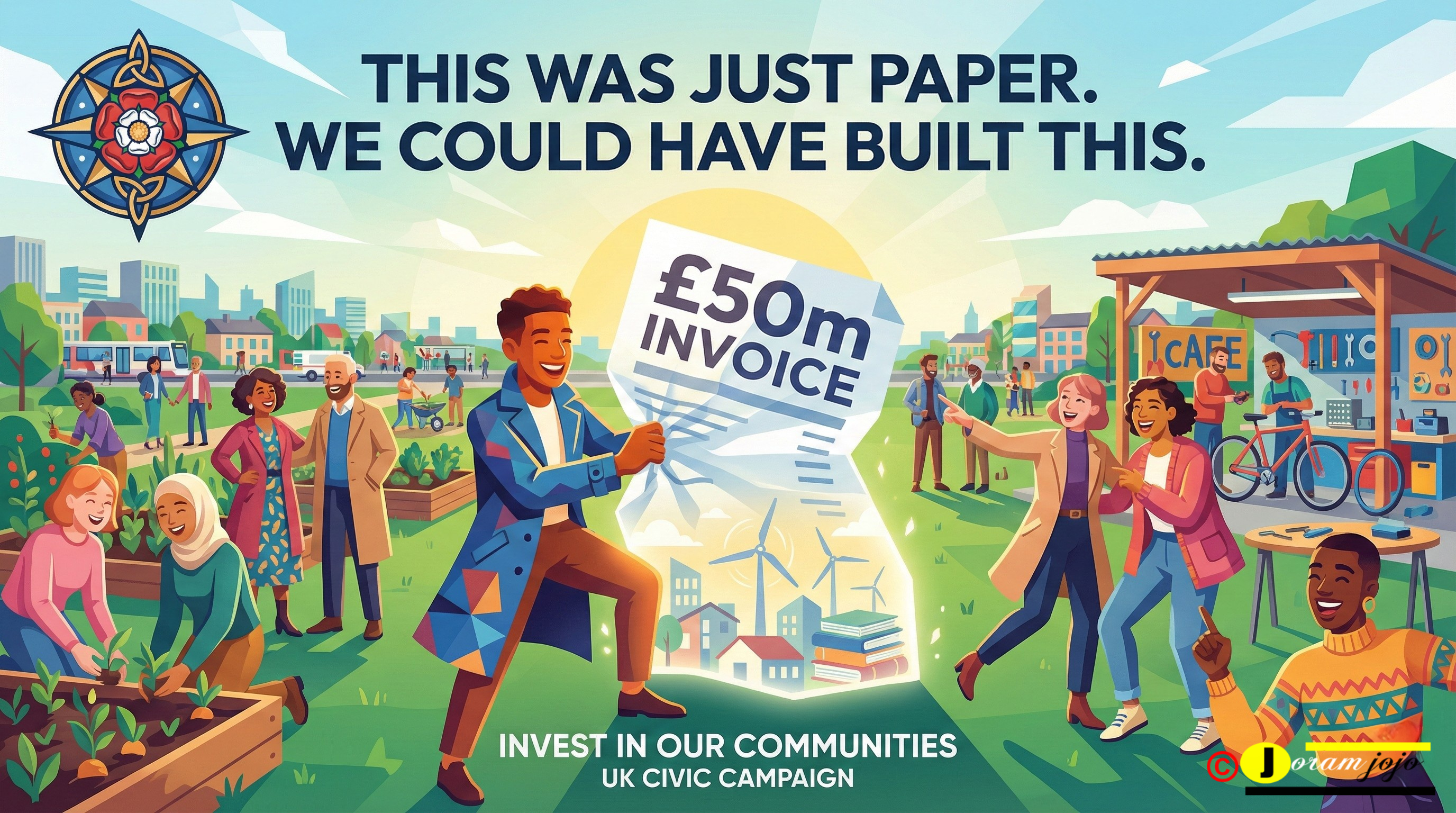 This is more than a mere political blunder to be weathered until the next news cycle. It is a stark indictment of an entire approach to governance. The system creates ‘fortress’ boundaries not because they work, but because their perpetual ‘crisis’ justifies its own expansion and the continuous movement of public wealth. The billions spent—on surveillance, on detention centres, on payments to regimes like Kagame’s—constitute one of the largest transfers of wealth from the public sphere in modern times. It is a direct pipeline from the taxpayer to the shareholder, from the council budget to the private security firm and the authoritarian state’s coffers.
As the public faces this fresh demand, the pressing question is not which political manager can tweak this border business for better returns. The question is why we accept the business premise at all. Why do we consent to a system that is demonstrably more adept at generating invoices for failure than fostering genuine safety? True security is not a product that can be purchased from a dictator or a contractor. It is cultivated from the ground up, woven from the fabric of functional communities, mutual support, and shared resources. It is built with homes, healthcare, and hope, not with barbed wire, biometrics, and bribes.

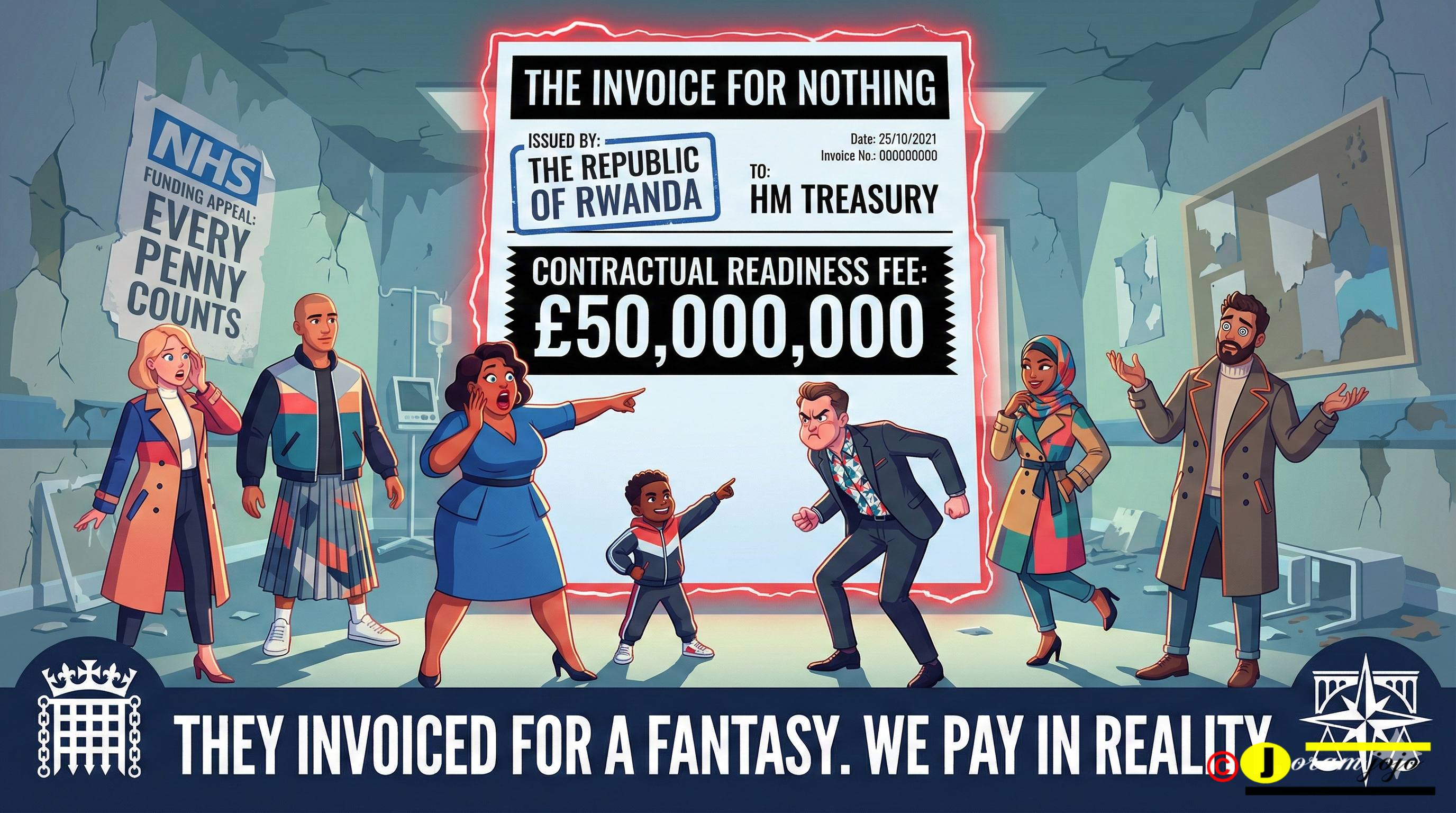
This sordid journey—from Kigali’s ready-but-empty hostel, to the elegant courtrooms of The Hague, to the bewildered scrutiny of the British public—serves as a clarion call. It is an invitation to finally reject a farce that impoverishes us in every sense: financially, morally, and socially. It urges us to refuse complicity in an economy that trades in human suffering, and to instead envision a different logic. One where our collective wealth is invested in building futures, nurturing communities, and fostering a cohesion so robust it has no need for the brutal, expensive theatre of walls. The lesson has been delivered. The bill is now due. The choice is whether we pay it and repeat the cycle, or whether we finally close the account.
Sub delegate
Joram Jojo

- Paul Kagame’s Rwanda Seeks £50m from UK in Deportation Dispute - January 28, 2026
- Paul Kagame’s Aggression: A Comprehensive Look at Rwanda’s War in the Congo - December 21, 2025
- Decoding the Washington Accords and the Fight for the Congo’s Future - December 5, 2025
RELATED PUBLICATIONS:
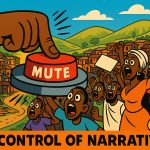 Rwanda Domestic List of Terrorists & Financiers 2025: Full Details
 MORE THAN 20 PEOPLE WERE FOUND LIVING IN ONE HOUSE
 FORTY TWO DRIVERS CAUGHT USING MOBILE PHONES AT THE WHEEL
 NEW SCAM CALLS MORE CONVINCING
 POLICE WARNING: BE CAREFUL WHEN USING PHONES OUTSIDE IN WINDSOR TOWN
 INCREASED POLICE PATROLS IN HIGH WYCOMBE AS A DETERRENT TO CRIMES
 THE THEFT OF THE RWIGARA BUSINESS BY PAUL KAGAME
 PAUL KAGAME HAS BEEN STEALING FROM RWANDANS
 GENOCIDE SUSPECT, FELICIEN KABUGA ARRESTED IN PARIS
 ANTI-VACCINE AND LOCKDOWN PROTESTERS DESCENDED ON CENTRAL LONDON
 MEMORIALS HAVE BEEN HELD FOR POLICE OFFICER SHOT DEAD, SGT MATIU RATANA
 ONE OF THE VICTIMS OF FRIDAY’S SHOOTING HAS ESCAPED
 TEN YEARS IN JAIL IF YOU HIDE THAT YOU’VE COME FROM RED LIST COUNTRY
 CRIMINAL PAUL KAGAME HAS MURDERED ANNE RWIGARA
 THE UK STATE SPONSORED PEOPLE TRAFFICKING TO RWANDA
 THE RWANDAN DICTATOR PAUL KAGAME COMEDY SHOW!
 Rwanda’s Complicity in Eastern DRC: A Trail of Exploitation and Suffering
 U.S. Treasury Sanctions James Kabarebe and Lawrence Kanyuka Kingston for Their Role in the Destabilizing Activities of M23 in the DRC
 Rwanda’s WASH Scandal: Governance Failure, Corruption & the Serena Hotel Smokescreen
 Paul Kagame’s Rwanda: The Dark Truth Behind Africa’s ‘Economic Miracle
 From President to Foreign Spy? The Stunning Allegations Against Joseph Kabila
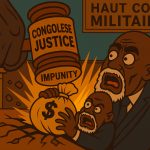 The Joseph Kabila Verdict: How Rwanda’s Proxy War Devastates Eastern Congo